
On My Plate: Food produced by co-ops
Co-ops come into existence when people decide that there is a gap in their community.
MOON Co-op is viewed by many folks in Oxford as a “mom-and-pop” grocery, with a friendly staff, offering healthy and earth-friendly food. Since Miami students returned to Oxford after the COVID-19 closure of the campus, they have comprised a larger share of shoppers at MOON Co-op. The students seem much more health-conscious than in the past, and they view MOON Co-op’s food to be the healthiest choice in Oxford.
The higher visibility of “MOON” as the go-to store for healthy food is gratifying to those involved with operating and managing the store, but what is less prominent for students and many year-round residents is the second word in the store’s name “co-op.”
October is National Co-op Month, as well as the anniversary of the opening of MOON Co-op 15 years ago, so this seems a suitable moment to explain why a cooperatively owned grocery store is not like other businesses in Oxford.
Co-ops come into existence when people decide that there is a gap in their community. For a cooperatively owned grocery, one of two gaps is typically identified. Some food cooperatives are placed in locations that are identified as food deserts, that is communities without a nearby grocery store. Gem City is a nearby example of a co-op grocery store that opened a few years ago in an underserved neighborhood of Dayton. Oxford is fortunate to have two large supermarkets, so we are clearly not a food desert.
Other food co-ops, such as MOON, are started when people see a gap in the offerings of the conventional supermarkets. In Oxford, several hundred households came together to open MOON Co-op 15 years ago because they saw a gap in the availability of local, organic, sustainable and other Earth-friendly products. For example, large supermarkets label a product sourced from 400 miles away as “local.” The Oxford Farmers Market offered local food, but for only three hours on Saturday mornings. Many of the growers at the farmers market were leaders in opening MOON Co-op as a place to provide local food seven days a week.
The United States has had three waves of co-ops. First came during the 1930s, when cooperatives helped people escape the poverty of the Great Depression. Butler Rural Electric Cooperative is a local example of a 1930s-era co-op that brought electricity to rural areas that were not served by big city electric companies.
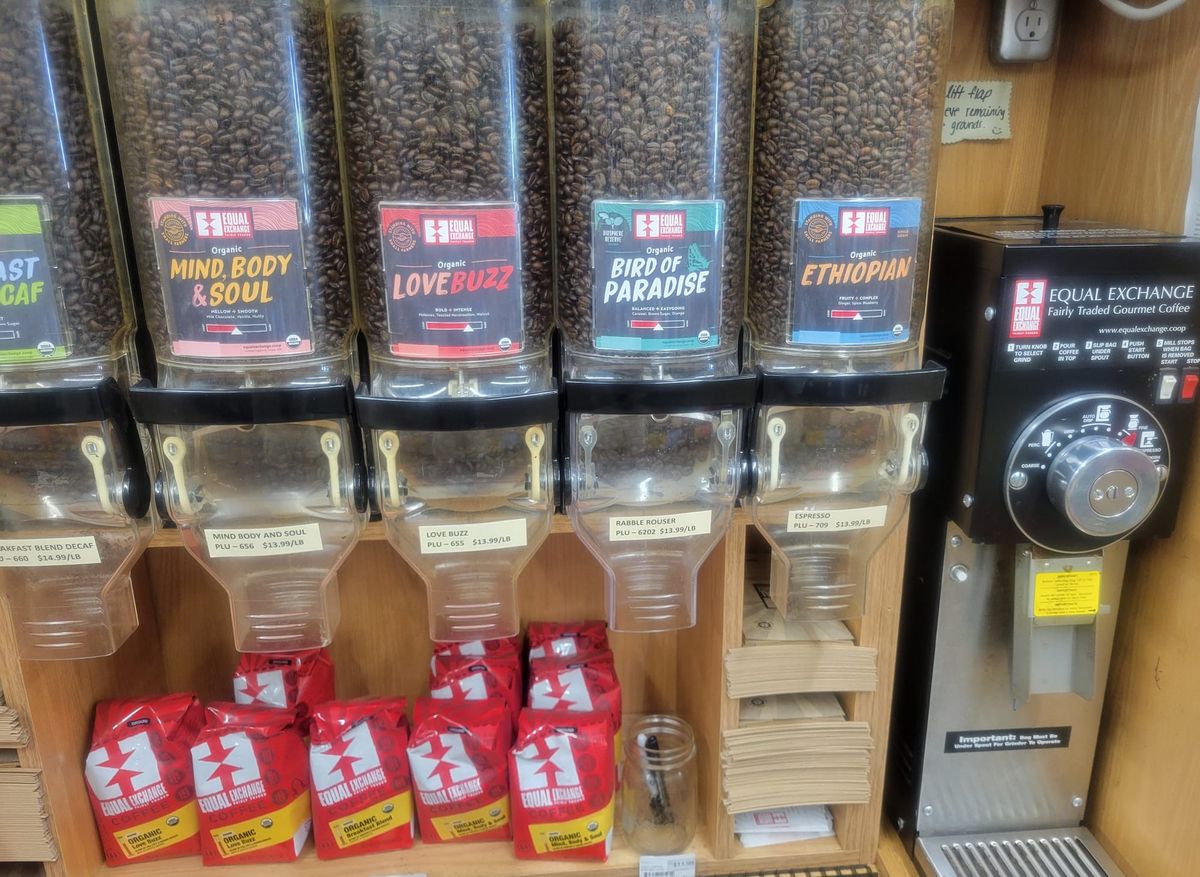
The second era of co-ops came in the 1970s and 1980s, when folks who had embraced counterculture lifestyles during the 1960s decided that they could better improve their lives and those of others by banding together to form cooperatives. Equal Exchange, MOON Co-op’s principal source of coffee and chocolate, is an example of a worker-owned cooperative.
All cooperatives, including MOON, adhere to seven international principles. One of the seven principles is that co-ops help other co-ops. Equal Exchange helps grower co-ops, primarily in northwestern South America, where coffee beans and cacao beans are grown organically with fair working conditions. The coffee grinder and coffee maker in MOON Co-op are gifts from Equal Exchange.
We are now in the third era of cooperatives, including MOON Co-op, as people decide that traditional forms of operating businesses weren’t meeting their needs or goals. In the United States, according to Food Cooperative Initiative, on average one new food co-op opens each month.
After 15 years of operation, MOON Co-op is now owned by 1,025 households, mostly living in or near Oxford. An annual meeting for all member-owners will be held on Oct. 25 at MOON Co-op, located at 512 S. Locust St.
James Rubenstein is president of the Board of Directors for the Oxford Free Press and professor emeritus of geography at Miami University.