
On My Plate: Kohlrabi
“Like other brassicas, such as broccoli, cauliflower, collards, and kale, kohlrabi is a nutritional superstar.”
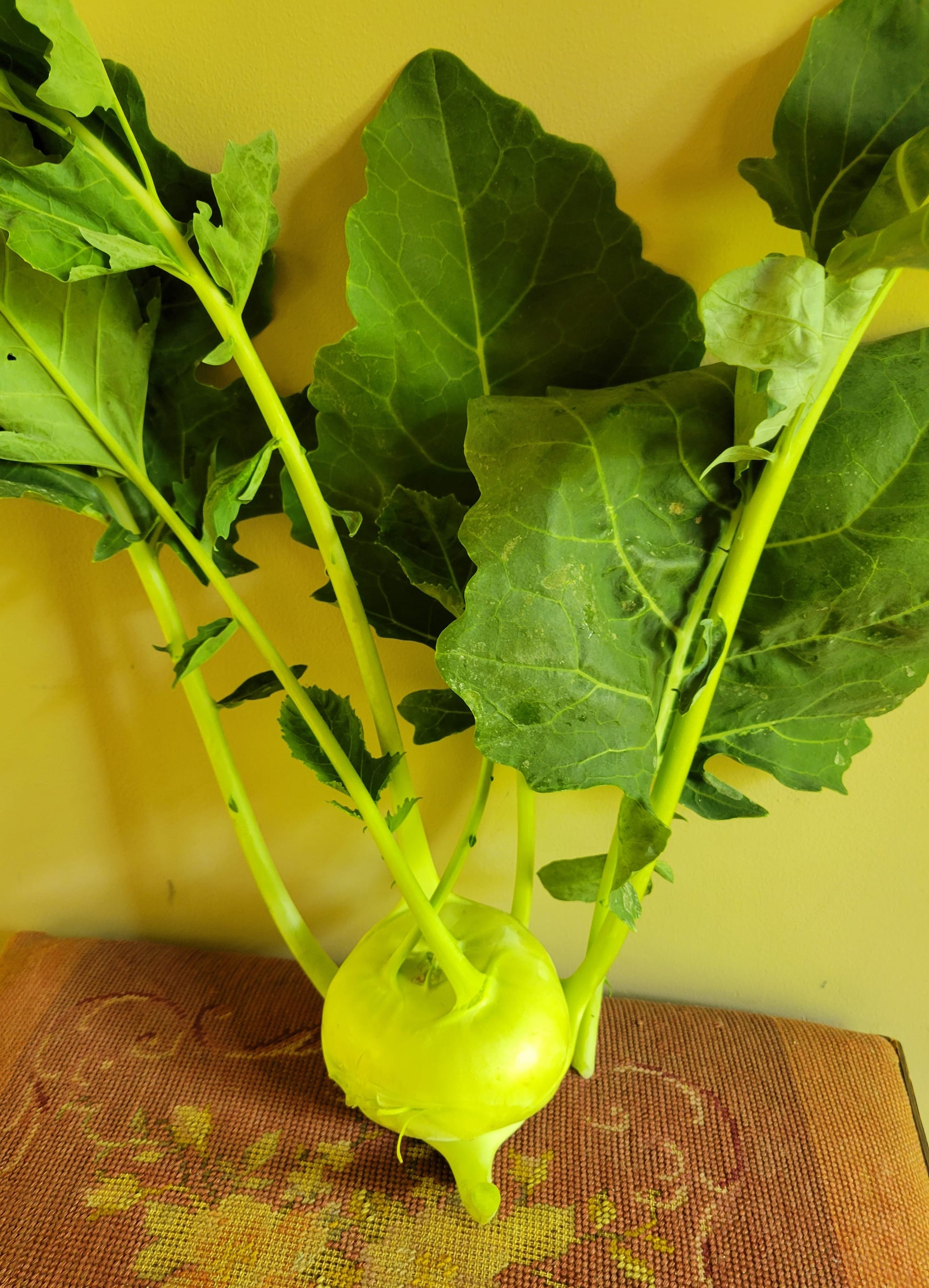
More than 10,000 satellites orbit around our planet, one or two of which fall back to Earth daily. Several of them appear to have fallen into Oxford’s Farmers Market, courtesy of Greg Hamm, who has had hundreds of them on his farm.
Claiming that his Sputniks are edible, Greg displays them in two baskets on his table at the farmers market. A few of them have arrived at MOON Co-op Grocery. These orbs are in fact kohlrabi. They are around 4 inches in diameter, weighing around 2 pounds, with several foot-long protruding antennas.
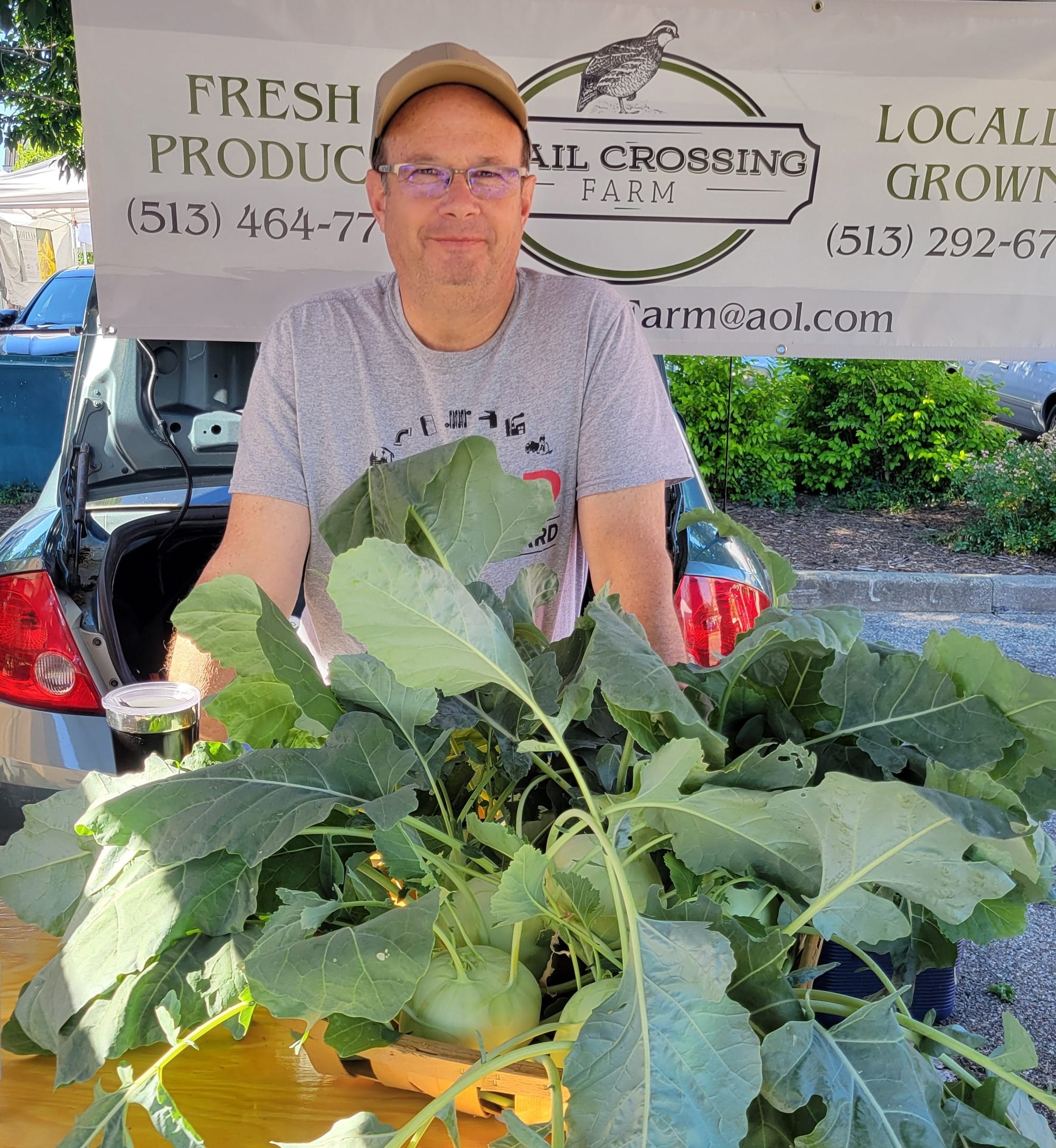
Greg Hamm is hidden behind his kohlrabi at the Oxford Farmers Market. Photo provided by James Rubenstein.
“Kohl” is German for cabbage and “rabi” is a Swiss German variant for “turnip.” Kohlrabi is a brassica, related to cabbage, but not to turnip, which is a mustard. According to harvesting-history.com, kohlrabi and Brussels sprouts are “the only commonly known vegetables of northern European origin,” hence the German and Belgian names for these two brassicas. Kohlrabi looks like a root vegetable, but it actually grows above ground, because the edible globe is the plant’s swollen stem.
Like other brassicas, such as broccoli, cauliflower, collards, and kale, kohlrabi is a nutritional superstar. According to the Cleveland Clinic, consuming kohlrabi helps to protect the heart, reduce inflammation and improve digestion.
A festival is held somewhere in the world for nearly every food, but AI is unable to identify a festival honoring kohlrabi. Hamburg, Michigan, which once called itself the Kohlrabi Capital of the World, hosted the Kohlrabi Festival from 1978 to 1988 featuring kohlrabi tasting and an ugliest kohlrabi contest. According to a 1985 United Press International story, Rev. Carl Frederick Welser, the founder and only member of the Hamburg Kohlrabi Grower’s Association, obtained a public apology from Bartles & Jaymes wine cooler after the company aired a TV ad asserting that their wine went fine with everything but kohlrabi and kandy korn.
Kohlrabi can be served raw or cooked. Raw kohlrabi is pleasingly crunchy, so it is the preferred method serving in our household.
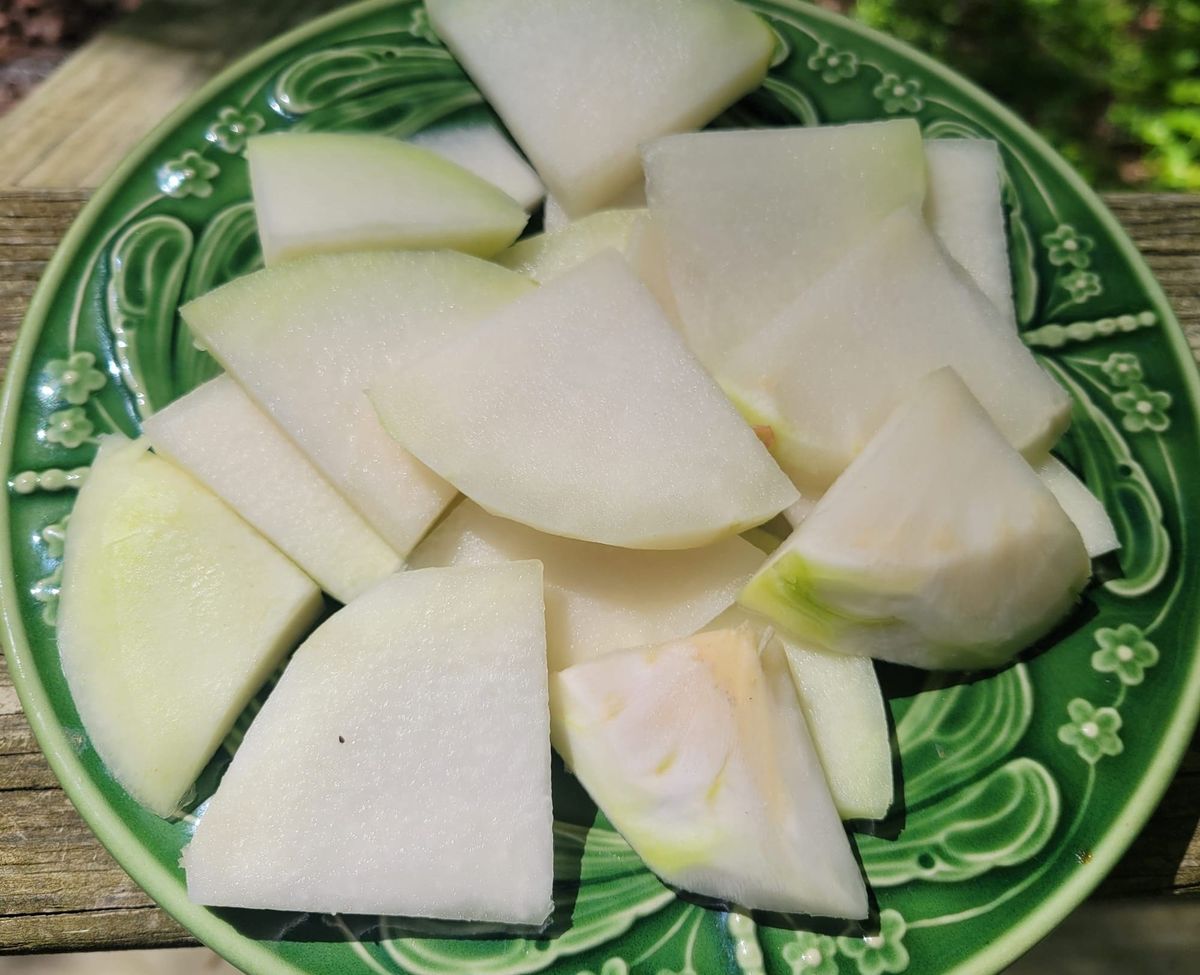
To deconstruct a kohlrabi for eating, the outer shell needs to be cut away with a knife, as it is too thick for a peeler. Best bet is to cut off the stems and leaves and chop the orb into four wedges before peeling. Another shopper told me last week that she uses a mandolin to slice kohlrabi.
Use raw kohlrabi like cabbage in slaw. Slice the peeled kohlrabi into very thin half-moons, then into very thin matchsticks, as thin as can be managed with a knife. If you prefer slaw more finely ground, grate or pulse chunks of kohlrabi.
After finely slicing or grating the kohlrabi, grate a carrot and perhaps some purple cabbage or kale for color. Mix with 3 parts mayonnaise and 1 part Dijon mustard and sprinkle in some garlic, dill, Mediterranean herbs and paprika. “Sunset Ideas for Cooking Vegetables” offers “Kohlrabi Salad Nicoise,” which adds to the above recipe of last week’s featured local vegetable sliced radishes.
Cooked kohlrabi is soft and a bit sweet. A 1973 edition of “The Joy of Cooking” has a recipe requiring boiling the pieces until soft, a method that causes it to lose most of its nutritional value and crisp taste. A better bet is a recipe from The New York Times to cook kohlrabi the same way as French fries.
German is a wonderful language, but finding an attractive name for a vegetable isn’t one of its assets. The French call kohlrabi chou-rave. I like that name, because if you actually try kohlrabi, you too will rave.
James Rubenstein is president of the Board of Directors for the Oxford Free Press and professor emeritus of geography at Miami University.