
On My Plate: Rhubarb
"Since Shakespeare’s time, rhubarb has become popular in England. Growers in Yorkshire, England, had particular success growing rhubarb beginning around 1800."
Rhubarb and strawberries make a classic spring pairing of local fruit. Rhubarb has appeared at Oxford Farmers Market, and strawberries will appear soon, according to a couple of the market vendors.
Rhubarb was once regarded as a medicine, principally as a laxative. Macbeth, as he nears his demise in Act 5 asks, “What rhubarb, senna, or what purgative drug, would scour these English hence?” In modern English he is asking, “What laxative would flush out the English?”
In reality, rhubarb leaves are poisonous and must be trimmed away; only the long, fleshy stalks are edible. Peeling the stalks is unnecessary but preferable for a smoother dessert.
Since Shakespeare’s time, rhubarb has become popular in England. Growers in Yorkshire, England, had particular success growing rhubarb beginning around 1800. A nine-square-mile area of Yorkshire is known as the Rhubarb Triangle. The Yorkshire growers use a technique known as forced rhubarb, in which plants spend two years in the field before being moved into sheds to continue growing in darkness through the second winter. The British consider the resulting rhubarb to be more tender than that grown entirely outdoors.
Yorkshire Forced Rhubarb has been designated a Protected Designation of Origin (PDO) by the European Commission (at least until Brexit). The town of Wakefield, in the heart of the Rhubarb Triangle, holds an annual rhubarb festival and has a 15-foot-tall sculpture of a rhubarb stalk.
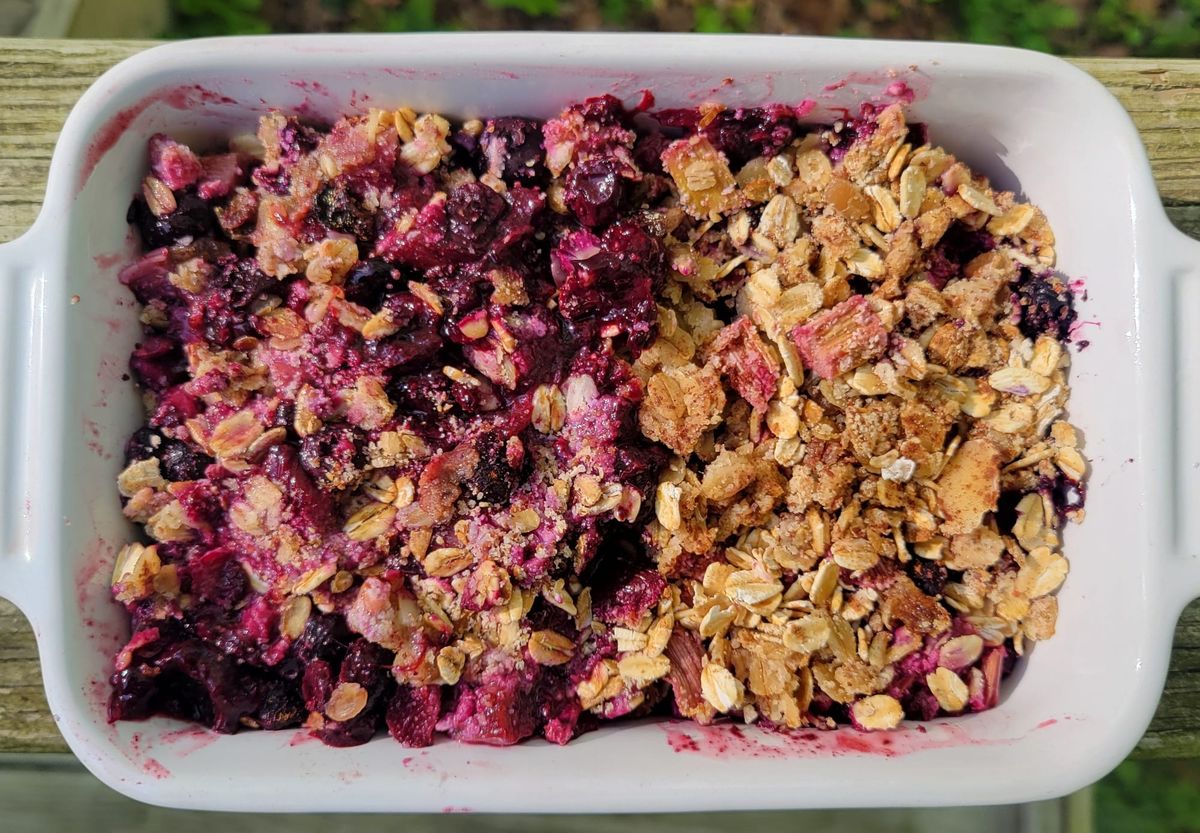
Everyone knows how to eat a strawberry – pop it in your mouth and enjoy the sweet burst of summer. In contrast, some assembly is required to appreciate rhubarb. This year, I baked fresh rhubarb with blueberries frozen from last summer, both from Johnson Family Farm.
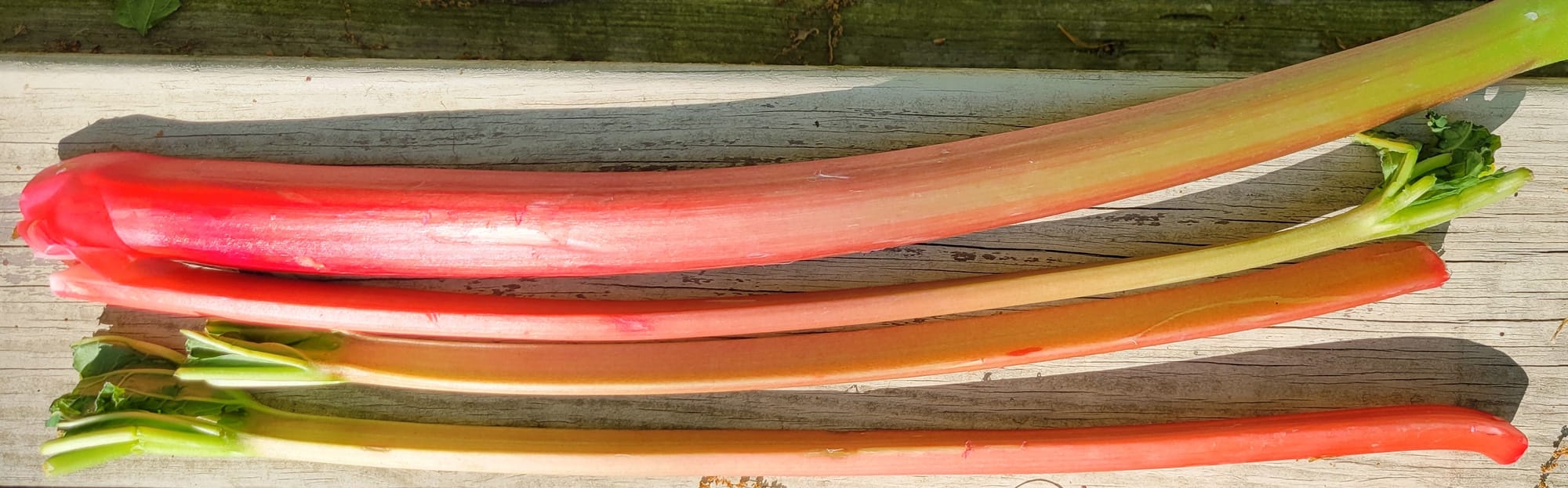
One year ago, my column on local rhubarb included the following two paragraphs about preparing rhubarb, which I am using again:
Jean Vance, Oxford’s distinguished painter, and a friend and neighbor, gave me a photocopy of a vintage recipe card for rhubarb pie “from the kitchen of . . .” Jean’s mother. The vintage recipe card handwriting was difficult for me to read, so Jean kindly walked me through the card’s shorthand. We clarified the ingredients and oven times and temperature, and Jean added some notes and comments.
Chop 3 cups of rhubarb (around 11 stalks), mix with 1 cup sugar and 3 tablespoons of flour, and place in a pie pan. Sprinkle bits of butter across the top, cover with foil, and bake at 425 degrees for 30 minutes. Remove the pan from the oven and discard the foil. Mix 1 egg, 1/4 cup sugar, 1 tablespoon flour, and 1/2 cup milk, pour over the rhubarb. The recipe notes say to use a three-tine fork to loosen the rhubarb so the custard mixes thoroughly with the rhubarb. Bake uncovered at 375 for 30 minutes.
Jean Vance passed away five months after I wrote about her mother’s rhubarb recipe. The family held a private service and she is interred near Cincinnati. Here is the notice prepared by Weil Kahn Funeral Home in Cincinnati.
Jean B. Vance (nee Brandow) passed away peacefully on Friday, Oct. 17, 2025, at the age of 79. She was born July 16, 1946.
She is survived by her husband, Carl, of 56 years, her loving children, Lezlie, Ashley (Jamie), Adam (Rachel) and grandchildren, Adley, Logan, Chase, Jenna, Leo and Samson. There will be a celebration of life in the spring. Services will be held privately at the convenience of the family. In lieu of flowers, memorials can be made to the Middletown Arts Center or the Oxford Community Arts Center.
James Rubenstein is president of the Board of Directors for the Oxford Free Press and professor emeritus of geography at Miami University.