

On My Plate: Sweet potatoes
According to linguists, the word for sweet potato is shared between Austronesian languages of Oceania and the Quechua language of northwestern South America. Crossing the Pacific Ocean 1,000 years ago in a canoe is an unimaginable feat.
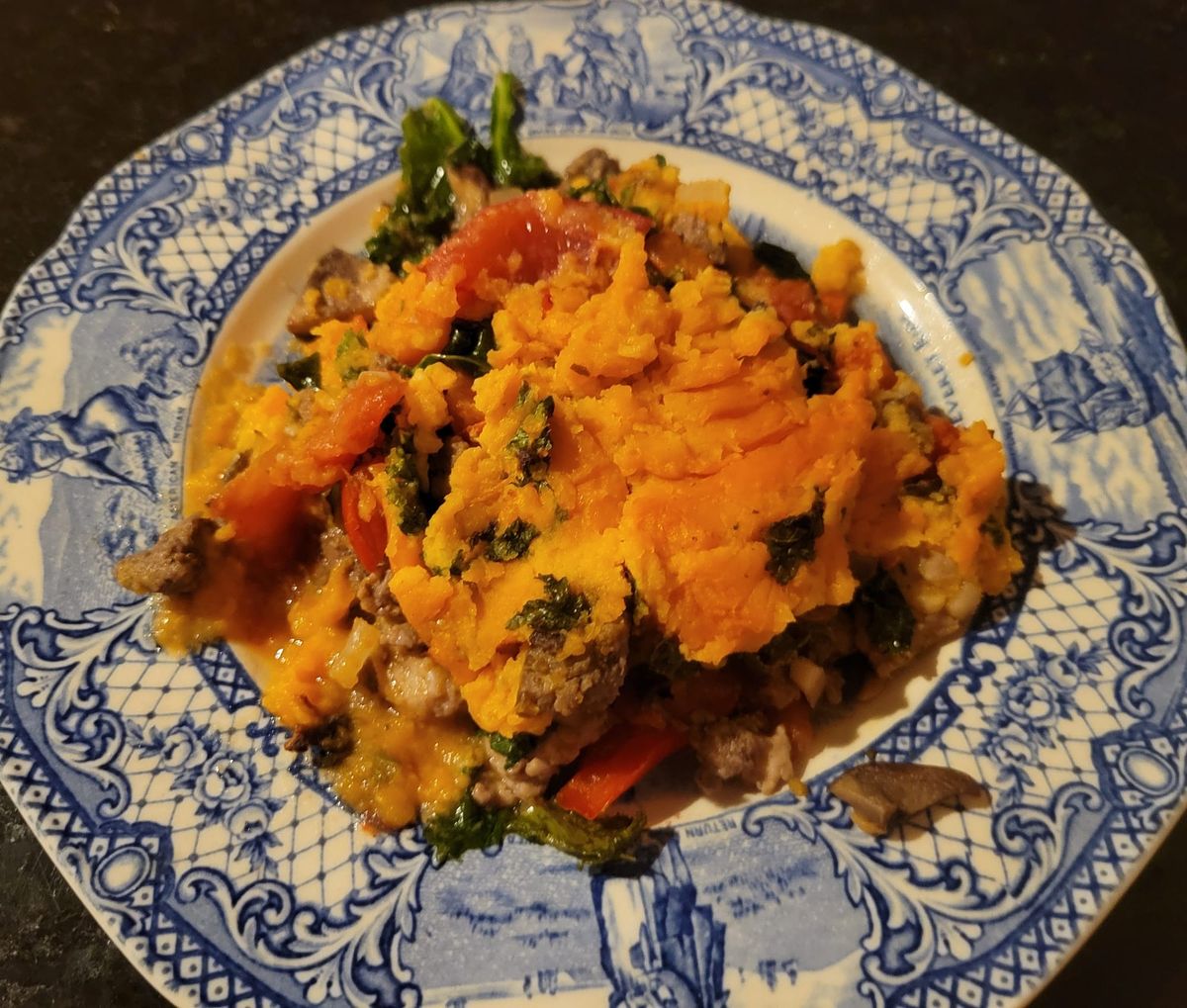
Last week, sweet potatoes appeared at the Oxford Farmers Market. That same day, I opened the latest issue of Cook’s Illustrated and found an article written by Vallery Lomas with the headline “Shepherd’s pie with a Louisiana twist: A sweet potato topping gives this classic British dish a dose of Southern comfort.” The food gods were clearly pointing to constructing a shepherd’s pie, with a lot more than only a dose of local Oxford ingredients.
The sweet potato was first domesticated at least 5,000 years ago in present-day Ecuador. Sweet potatoes and white potatoes are not evenly closely related botanically. Sweet potatoes belong to the morning glory family, rather than a nightshade like white potato, which was first domesticated in Peru perhaps 10,000 years ago.
The Spanish conquerors took the sweet potato back to Europe, where it was regarded as a strong aphrodisiac, including by the two most famous English gluttons, Henry VIII and Shakespeare’s Sir John Falstaff.
Several hundred years before the arrival of Europeans to the Americas, sweet potato cuttings were carried from South America to Pacific islands, including the Cook Islands, where they have been radiocarbon-dated back to 1000 C.E.
According to linguists, the word for sweet potato is shared between Austronesian languages of Oceania and the Quechua language of northwestern South America. Crossing the Pacific Ocean 1,000 years ago in a canoe is an unimaginable feat.
Nearly all U.S. sweet potatoes are grown in the southeast, with North Carolina accounting for around 60% of total production in this country. They are a rarity around here, though 7 Wonder Farm sweet potatoes are pleasingly dirty, suggesting that they have come out of the ground only hours before showing up at the farmers market.
Sweet potatoes are rarely consumed in most of the United States except as a side dish at Thanksgiving. Actually, it is probably the least authentic of the popular Thanksgiving dishes, because they didn’t get to the United States until the 19th century influx of immigrants from Europe.
Sweet potatoes are frequently mislabeled as yams in the United States by marketers wishing to distinguish those with orange flesh from paler ones. A true yam, a root found in Africa, is botanically different from a sweet potato, and is rarely sold in the United States. The deeper the color of the flesh, the greater the antioxidant content.
Inspired by the Cook’s Illustrated story, it was a simple matter to construct a shepherd’s pie using only ingredients obtained at Oxford Farmers Market. For the base of the pie, I sauteed in Kofinas olive oil a combination of ground beef from Caraway Farm and ground sausage from 7 Wonders Farm. I added to the frying pan some chopped tomatoes, garlic, bell peppers, onions, mushrooms and shredded kale, from several local vendors. The cooked mix then was spread on the bottom of a baking dish.
Lomas used different ingredients in the Cook’s Illustrated recipe, but with respect to the author, frozen peas and supermarket carrots appealed less to me than whatever was available at Oxford Farmers Market.
Meanwhile, microwave the sweet potatoes until soft. “One of the greatest traits of the sweet potato is that it can be microwaved and emerge smooth and velvety,” according to Lomas, “whereas microwaving a russet potato renders it gummy.” Mash the potatoes, spread on top of the meat base and broil for five to 10 minutes.
So there you have it: Shepherd’s pie with an Oxford twist. The final product was not very attractive, but neither was the photo in Cook’s Illustrated.
James Rubenstein is president of the Board of Directors for the Oxford Free Press and professor emeritus of geography at Miami University.