

OPD proposes new oversight for Flock cameras

City council will consider six recommendations after residents raised concerns about privacy, surveillance and access to camera data.
After weeks of public concern over Oxford’s Flock Safety cameras, Oxford’s Police and Community Relations and Review Commission (PCRRC) voted on Aug. 6 to send a series of recommendations to the Oxford City Council with the goal of increasing transparency and oversight.
Flock cameras, which use automated license plate recognition (ALPR) technology, capture images of vehicles in public view, collect full and partial license plates and report vehicle characteristics, such as color, make, model and even unique traits, like stickers.
OPD recommendations
After hearing a presentation from Oxford Police Chief John Jones and comments from the public, the PCRRC voted to send the recommendations from the Oxford Police Department (OPD) to the city council for a vote on Aug. 18 on how the city will approach the Flock contract.
The first recommendation would give the public access to the OPD’s Flock Transparency Portal, which allows members of the public to access information about how the system is used.
According to the Flock website, “The portal can include policy information, usage statistics, and sharing details. It can also include a public-friendly search audit that shows fields such as case number, search reason, offense type, anonymized user identifier, and the number of cameras or networks searched.”
Jones shared that one frequent concern he has heard is that while locals trust the OPD, they don’t know what other agencies are doing with its data. The second recommendation focuses on this by limiting network sharing to only Butler and adjacent counties.
The third recommendation would increase training for users of the OPD’s Flock system.
The fourth recommendation would have the OPD start recording cases solved with assistance from Flock cameras.
The fifth recommendation would require OPD command staff to send its monthly audits, which would review what data is searched, to the PCRRC for review. Jones said he has talked with other agencies who have used audits in this manner and believes implementing this tactic and allowing the public to see how the OPD is using the Flock system would be beneficial.
The sixth recommendation would see the OPD utilize Flock’s Audit Assistance tool, which can help identify atypical search patterns, single-user plate searches, searches beyond a 30-day timeframe for the same plate and exclusive external network searches repeated in a narrow timeframe. If flagged, an alert is sent to administration staff for review.
If the Oxford City Council votes to terminate the contract, the city will still be responsible for paying for the cameras until it ends in February 2027, according to Jones.
Public concerns
In his presentation, Jones discussed the concern of mass surveillance, which typically includes the identification and continuous monitoring of individuals, the tracking of specific individuals and their patterns, the collection of personal data and information and a lack of transparency and oversight.
Jones clarified Flock cameras do not use facial recognition, identify drivers or passengers in a photographed vehicle or use GPS tracking. Additionally, Flock cameras don’t track names of vehicle owners, interior vehicle details, personal conversations, cell phone data or any real-time tracking of individuals.
Tom Cooke, Oxford Township Trustee, shared his concern about other agencies accessing and misusing the data collected by Flock cameras in the area.
Cooke asked Jones a hypothetical question: Could agencies with access to OPD’s Flock system data track his vehicle’s whereabouts, identify patterns and potentially “take action” against him?
Jones said while this would be a violation of system use, the scenario was “feasible” for agencies that have access to the OPD’s network.
“If there was no probable cause or criminal reason to run your plate,” Jones said, “they would likely be in violation of their own policy.”
Susan Callan, a clinical social worker in Butler County, spoke about some concerns brought to her by her clients, specifically regarding privacy and misuse of collected data.
“I would think that this technology could indeed be used for good, but, of course, it also could be used for not good,” Callan said. “That is the part that is concerning for me – particularly for my clients.”
Ann Fuehrer, an Oxford local, spoke about the importance of public input in decision making.
“I, personally, support local law enforcement having access to tools that will make work more efficient, cost-effective and successful at apprehending people who break laws,” Fuehrer said. “However, when you use a rapidly evolving technology for its privacy … (it) provides tools for bad actors, reinforces corporate corruption and greed and erodes community trust in whether we are being protected and served.”
Fuehrer added that while she would like more auditing guardrails, she suggested more careful consideration when weighing the decision to either continue the contract with Flock or end it completely.
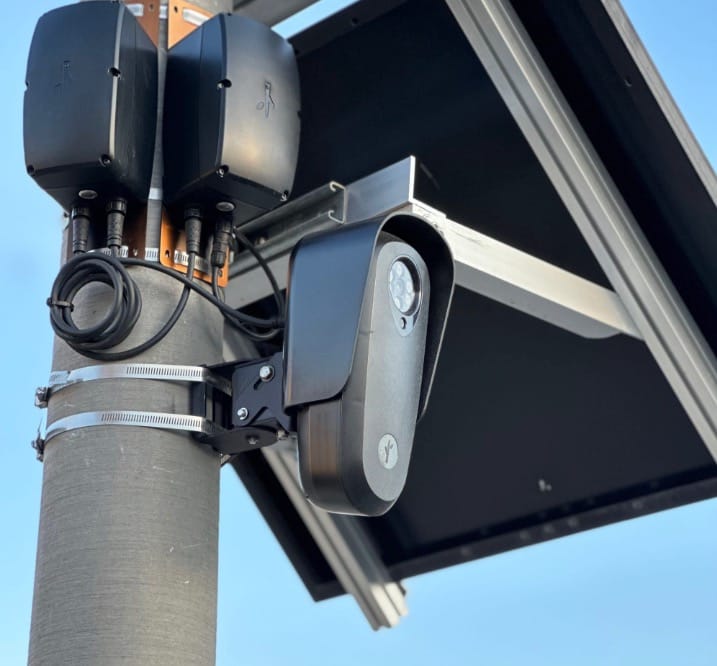
Network sharing
During the presentation, Jones said 2,215 state and local agencies – a number that will decrease if city council approved the department’s recommendations – have access to data collected by Flock cameras in Oxford. None of these are federal agencies, such as the United States Immigration and Customs Enforcement agency, Jones said. Additionally, the OPD has applied “filters” to prevent search features for immigration enforcement and reproductive care.
Additionally, Flock has never had a data breach, Jones said.
Privacy protections are also utilized by the OPD, according to Jones’s presentation. Every search of the Flock system’s data is reviewed and audited, and any use that violates the department’s policy will result in discipline. Illegal searches will result in criminal charges.
While Jones said human errors are always a possibility, he said the OPD applies a strict training policy and procedures to help prevent errors.
Jones confirmed with the Oxford Free Press that no OPD officer has misused the department’s system.
Response from Flock
On Aug. 7, the Free Press reached out to Flock for an interview and comment. A comment was given by Flock in response to the following questions by the Free Press:
- How do you respond to concerns that Flock cameras contribute to mass surveillance?
- What safeguards does Flock have in place to prevent law enforcement agencies from misusing camera data?
- What would you say to Oxford residents who are questioning whether the city should continue using Flock cameras?
Courtney Terlecki, spokeswoman for Flock, said in response that the company is open to having conversations with people about privacy concerns.
Terlecki also shared that courts across the United States have ruled that fixed license plate readers do not violate the Fourth Amendment, which protects citizens from unreasonable searches and seizures by the government.
The Flock website shares multiple court cases in which it was ruled that ALPR cameras do not violate the Fourth Amendment.
In January, two residents of Norfolk, Virginia, lost a case against the City of Norfolk when a federal judge sided with the city, saying the Norfolk Police Department’s use of Flock cameras was fully compliant with the Constitution.
However, the judge on the case noted that evolving technology can “make it impossible to predict how police surveillance will evolve (and) the Fourth Amendment analysis must remain nimble even as it remains grounded in founding-era traditions.”
Terlecki said in the statement that data collected by Flock’s customers – agencies like the OPD using Flock cameras – are owned and controlled by its customers.
Additionally, Terlecki said data sharing is not enabled by default and agencies control who can and cannot access their data.
“Every search requires a documented law-enforcement purpose and creates a permanent audit record showing who searched, when and why,” Terlecki said in the email, adding Flock’s Audit Assistance can help agencies “identify unusual search patterns for review.”
Terlecki said Flock cameras have had a “real impact” in Ohio.
“In July alone it has alerted to more than 600 sex offenders and 51 missing people statewide,” Terlecki said in the Aug. 7 emailed statement. “Just this week it was used to find a missing person in Ohio.”
The Oxford City Council will meet at 7:30 p.m. on Aug. 18 at the Oxford City Courthouse, 118 W. High St, to decide how to approach the city’s future with Flock.