

Sergiy Kostrikov’s visit
If asked what people in Oxford and the United States can do to help, Kostrikov responded they already have helped. “Ukrainians ‘know’ that the American people support their cause,” Kostrikov explained.
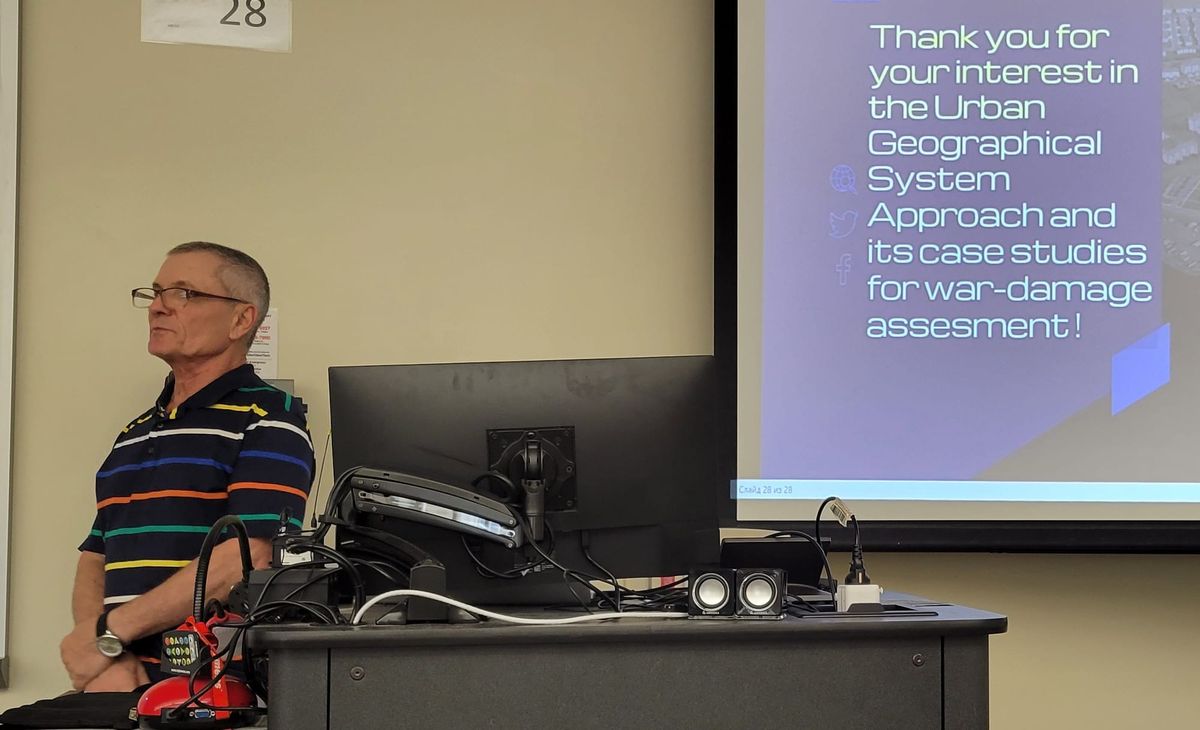
Daily life in Kharkiv, Ukraine’s second-largest city, is a surreal mix of normality and hell.
“We go to work and school in the morning, as always,” explained Sergiy Kostrikov, a professor of human geography in Kharkiv. “The difference is that when we head home at night, we won’t know if our home is still standing, or if we will even still be alive.”
Kharkiv Mayor Ihor Terekhov told the United Nations “just staying alive is exhausting.”
Kostrikov, an expert in geographic information system (GIS) and remote sensing, is working in Miami’s Department of Geography for a month. Some day, when the war is over, Ukraine will face a massive challenge of rebuilding its devastated buildings and infrastructure. Because this task will overwhelm traditional manual methodology, Kostrikov is leading an effort to apply geographic techniques to identifying priorities for the future reconstruction.
The city of Kharkiv is in the far northeast of Ukraine – only around 50 miles from the front line where the Russian invaders have dug in for the past four years. In comparison, Oxford’s sister city Dubno is 500 miles west of the front line.
On average, two Russian incendiary devices hit Kharkiv daily.
In the early days of the attack, Russian troops reached the northern outskirts of Kharkiv before being pushed back to the current line around 50 miles northeast of the city. As a result, the northern neighborhoods of the city suffered the most severe damage. According to a recent United Nations (U.N.).N. report, Kharkiv has suffered the greatest level of destruction among Ukraine’s major cities. Kharkiv Mayor Terekhov told the U.N. that around 10,000 residential buildings and 3,000 other buildings have been damaged, and around 160,000 have lost their homes.
Despite the daily attacks, in-person education continues. At V. N. Karazin Kharkiv National University, where Kostrikov is Professor in the K. Niemets Department of Human Geography and Regional Studies, in-person classes now meet in several hundred underground classrooms that the university has constructed since the Russian invasion began in 2022.
Karazin University’s curriculum has been modified in response to the Russian attack. Students now learn relevant skills, including first aid training, civil defense procedures, drone operations and broader military preparedness. The first university building to be destroyed by the Russians housed the physics department. Kostrikov believes that the choice was not random, because the Kharkiv Institute of Physics and Technology has a strong international reputation for nuclear research.
The City of Kharkiv’s elementary school and high school classes also meet in person underground. Many school buildings have been destroyed by Russian incendiary devices, and remaining ones are not safe for bringing together a large number of children. Underground schools are under construction, but until enough are completed, many grade school classes are held in Kharkiv’s subway stations.
In teaching the students in his city planning courses to think about the future, Kostrikov has practiced what he preaches. Anticipating that the Russians would some day invade his country, Kostrikov moved with his wife, 3 dogs, 4 cats, and parrot to a cabin deep in a forest near Kharkiv. The family’s eight pets were taken in after their previous owners were lost to the war.
Kostrikov has escaped physical injury thus far. To reach the United States, he left his home a day earlier than necessary, traveling by train to reach Poland for a flight to O’Hare. The next day, the train he had taken was bombed by the Russians. In his PowerPoint presentation for GIS students and faculty in the Miami Geography Department on Sept. 18, Kostrikov added a slide showing that the Kharkiv shopping mall he had recently frequented has been destroyed by a Russian attack on Sept. 17.
Kostrikov’s son has served in the Ukraine Army since 2014. He has suffered what Kostrikov says “minor” injuries, but that has included the insertion of a metal plate in his back. However, most of his son’s friends have been killed in the war, according to Kostrikov.
The apartment in Kharkiv that his family maintains while living primarily in the forest suffered damage from an air attack, knocking out his neighbors’ windows. As a city planner, in anticipation of such an attack, Kostrikov had applied tape to all of the apartment’s glass, so unlike his neighbors, Kostrikov’s apartment still has its windows in place.
While the war goes on, and attacks continue, Kharkiv’s leaders have already started to plan for a post-war future. Kharkiv’s new master plan is focused on “sustainable infrastructure, affordable housing, innovative public spaces and economic renewal,” according to a recent U.N. report. Kostrikov’s highly technical work that he is working on this month in Miami’s Department of Geography is contributing to the city’s master plan for the future. To use a military medical term, Kostrikov’s work facilitates Kharkiv’s leaders as they triage the city’s remaining buildings and infrastructure into those that are safe, those that need rehabilitation, and those that need to be demolished. His work will also help the city identify optimal locations for new facilities, such as schools.
According to the U.N., “amid the destruction, Ukraine’s second-largest city is doing something that may seem almost impossible during wartime: preparing for a better future.” Kharkiv’s mayor reports that around 4,000 buildings have already been restored, a reflection of the resiliency and commitment to a better future in Kharkiv.
While Kostrikov is here for a month to share his already formidable technical skills, he is also eager to talk about daily life in Ukraine’s war zone. His first presentation to geography and urban planning students was met with stunned silence. When he asked for their questions or comments, Miami students did not know what to ask or say – they were too shocked to talk.
If asked what people in Oxford and the United States can do to help, Kostrikov responded they already have helped. “Ukrainians ‘know’ that the American people support their cause,” Kostrikov explained.
In his first week in Oxford, experiencing that support in person has already given him something of great value to take back to Kharkiv. Kostrikov will be in Oxford until Oct. 12 and can be reached through Miami’s Department of Geography; Havighurst Center for East European, Russian and Eurasian Studies; or the writer of this article.
James Rubenstein is president of the Board of Directors for the Oxford Free Press and professor emeritus of geography at Miami University.