
Talawanda board hears financial forecast, discusses student debt penalties
Tafelski told the board “uncertainties” surrounding the district’s revenues and expenditures are still “very much alive.”
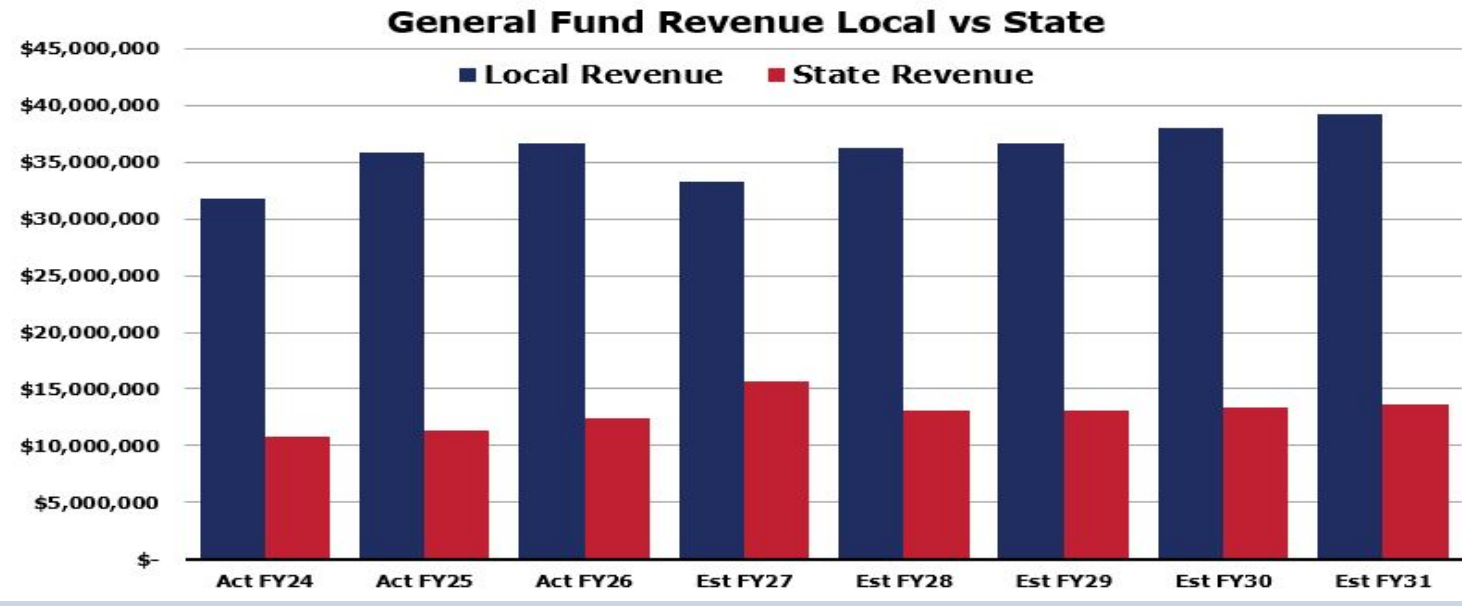
Revenue for the Talawanda School District (TSD) is expected to see little relative growth over the next five fiscal years, while expenditures steadily increase, according to the five-year financial forecast presented by Treasurer Shaunna Tafelski during a board of education meeting on Aug. 13.
The complete forecast is available on the TSD website under “Board of Education” and “Agendas.” The PDF for the report is under the financial forecast item on the Aug. 13 meeting agenda.
According to Tafelski’s forecast, the predictions are updated to reflect the most current economic data for the August 2026 filing. Several events could impact the financial outcomes of later years in the forecast, including state budgets, new state mandates, levies, property appraisals, salary increases and other changing factors.
Tafelski told the board “uncertainties” surrounding the district’s revenues and expenditures are still “very much alive.” Still, a general prediction graph presented by Tafelski showing the projected revenues and expenditures for Fiscal Year (FY) 2024 through FY31 depicts steadily increasing costs with some rise in revenues, leading to possible deficit spending in FY30 and FY31.
Tafelski brought up several current and possible future legislative changes which may affect the forecast.
On Dec. 19, 2025, Gov. Mike DeWine signed into law Ohio House Bill (HB) 129, HB 186, HB 309 and HB 335. The state budget correction bill, HB 479, was also signed on June 24 of this year and will become law on Sept. 23.
According to Tafelski’s report, HB 186 is particularly concerning, as it established “inflation cap credits” and a “retroactive clawback” of realized revenues. This means it implements property tax caps following reappraisals and triennial updates that act retroactively for property appraisals occurring in tax years 2023, 2024 and 2025.
It also includes a provision that takes back tax revenue already collected by school districts starting with reappraisals and triennial updates occurring before the effective date of the law, leading back to tax year 2023.
Essentially, school district property tax revenue will be capped to the rate of inflation for properties located in school districts subject to the 20-mill floor, which includes Talawanda. The property owners will receive credits on their tax bills for taxed amounts that exceeded the inflation limits. This includes temporary credits for amounts collected in the three previous tax years.
According to Tafelski’s forecast, “These are funds that have already been realized and have been spent and/or included in future educational planning.”
According to the Ohio Department of Education and Workforce website, HB 186 provides a property tax revenue supplemental payment in 2026 and 2027 to school districts when tax credits result in a reduction in property tax revenue. The website includes a spreadsheet of these payments made to Ohio school districts, including one made to the TSD of nearly $2.8 million, or around the current anticipated loss to the district.
Still, Tafelski told the Oxford Free Press in an email the inflation cap credits could cause the district to lose upwards of a cumulative $15.5 million through FY31, which she said is a “very conservative number” in the outlying years.
HB 129 reclassifies fixed-sum levies to be included in 20-mill floor calculations, but Tafelski said the district is not anticipating any impacts from this legislation.
HB 309 empowers county budget commissions to reduce levies approved by voters, which would create “unpredictable risk” to local levy yields, according to the forecast.
HB 335 limits revenue growth from unvoted property taxes, or inside millage, to the GDP deflation factor during reevaluation cycles. According to the forecast, the TSD has adopted a “defensive strategy” of projecting at or below the anticipated GDP deflation factor to prevent the state from applying further downward adjustments to the district's growth potential.
Butler County Commissioners approved the Piggyback Homestead Tax Exemption under HB 96 for tax year 2025, which will result in estimated tax reductions of around $242,000 for the TSD, impacting both FY26 and FY27 moving forward. Although Butler County Commissioners did not vote by July 1 to approve Piggyback Property Tax Exemptions for tax year 2026, according to Tafelski’s forecast, it could be a “financial risk” to future revenue collections.
The state budget represents 32% of TSD revenues, which is an “area of risk,” according to the forecast.
Tafelski said she typically forecasts a 2.7% annual increase in school district income tax collections, but she increased this to 3.5% after seeing recent trends.
But there’s uncertainty around whether the school funding guarantee will continue, which ensures districts that are losing enrollment will not receive less funding than baseline historical amounts, Tafelski said.
Tafelski said the guarantee is a “very big component” for Talwanda’s budget, and the district would need an additional 100 students to move away from needing the guarantee. For FY27, Tafelski said the district will receive $4.3 million from being on the guarantee.
Penalties for student debt
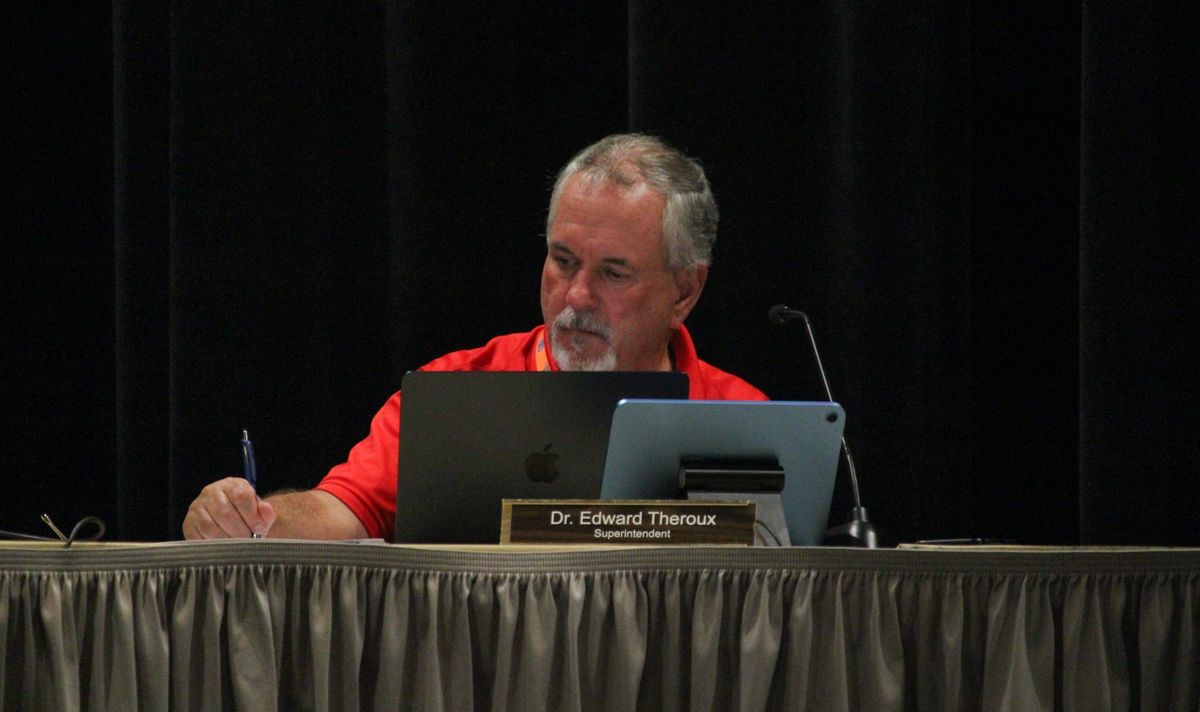
Superintendent Edward Theroux told the board the school district is moving forward with implementing penalties for students who have a debt on school fees whose families have not otherwise set up payment plans.
During a board meeting on June 18, Theroux told the board Talawanda High School students owed more than $85,000 worth of fees at the end of the 2025-26 academic year. This debt could include accumulated lunch, Chromebook, library, science lab and other dues.
Theroux said if the debt is not paid or a payment plan is not set up with the school, penalties for students could include them being unable to attend homecoming dances and other activities.
“If a payment plan is in place, and we’re working towards it, we will let students participate in those types of activities,” Theroux said, explaining the sooner parents and guardians begin payment plans, the less likely dues are to rack up.
Theroux said in an email to the Oxford Free Press that parking passes were not permitted to students with accumulated debt in previous years, and some students were prevented from walking during their graduation ceremony.
Board Member Dawn King expressed concern over the idea of “punish(ing)” students for their parents’ or guardians’ debt.
“I’m sure there are parents who have not paid because they cannot afford to pay, and there might be parents that are not paying because they just choose not to pay,” King said. “But it doesn't seem fair at all to the student to bear the brunt of that.”
Theroux asked if the board wanted to instead pay off debts or eliminate fees through the general fund.
Tafelski gave a “caution” to the board about using the general fund to pay for fees, saying there are “mechanisms in place to assist the families who are in need,” including free and reduced lunches.
“At what point in time are you going to say we’re going to wipe out everyone’s debt if they have one, and then you have other parents who are paying on a repetitive basis?” Tafelski said.
Board President Rebecca Howard said, “The idea of the district just eliminating fees to me is just … not workable,” although she’s willing to hold reservations about the new penalties.
Board Member Matt Wyatt shared similar sentiments, saying he doesn’t think it’s “fair” to families who struggle to pay the fees but still keep up to wipe them out for other families.
Board Vice President Pat Meade said while there are ways to help families struggling, “For the student who has a parent that could be paying fees but is choosing not to … that student suffers for a choice of their parent, and unfortunately, that's a reality of life.”
“Young people suffer all the time for the choices of adults around them, and I don't know if we can fix that,” Meade said.
The complete agenda for the Aug. 13 meeting is available on the TSD website under “Board of Education” and “Agendas.” The board will meet again at 7 p.m. on Sept. 17 in the Talawanda High auditorium.