
Talawanda sees increase in transportation costs related to students experiencing homelessness
“It is unfortunate that we (and in any school district) have families/students without housing. We also know that by keeping students in one district (as much as possible)... ensures consistency that these students are often not having in their lives.”
The Talawanda School District is seeing an increase in costs for transportation associated with students experiencing homelessness.
Superintendent Edward Theroux told the Talawanda Board of Education during a meeting on June 18 the district was seeing an “increase in homelessness” and increased costs associated with transporting students experiencing homelessness, including for a service the district provides called EverDriven.
EverDriven is a national alternative school transportation company which “(provides) students who are experiencing homelessness with safe, predictable transportation to and from school (to deliver) much-needed stability and access to education,” according to the website.
Under the McKinney-Vento Act, students experiencing homelessness are federally ensured access to free, appropriate public education. It defines “homeless children and youth” as “individuals who lack a fixed, regular, and adequate nighttime residence.”
This act refers to children and youths who are sharing the houses of other people due to a loss of housing or economic hardship; those living in motels, hotels, trailer parks or camp grounds; those living in emergency or transitional shelters; those abandoned in hospitals; those with a nighttime residence in a public or private space not designed for regular sleeping for human beings; those living in cars, parks, abandoned buildings, substandard housing and bus or train stations; or “migratory children.”
In the State of Ohio, this means providing those students with transportation options, even if they’re beyond the typical bus routes.
Although the McKinney-Vento Act requires accommodations like those provided by EverDriven, Theroux told the Oxford Free Press in an email federal funds do not cover the full costs of the service.
Theroux said EverDriven “is like an Uber service,” in that credentialed, vetted drivers pick up students in cars or vans, especially ones who are out-placed, or live outside the bounds of the school district. He said in June the district had around five to 10 students logged, which ebbs and flows throughout the year as students’ families’ situations change.
“These families often struggle with a structure or the same house, so they would be going to multiple, possibly multiple different school districts, and that's not good,” Theroux told the Oxford Free Press. “I understand the theme of (the McKinney-Vento Act) is to ensure that kids have some consistency, so they're not bouncing (to) all different schools.”
A public records request from the Oxford Free Press to Talawanda Schools showed 33 students, or 23 families, were categorized as experiencing homelessness last school year. The Oxford Free Press reached out to school district staff for more information, including data from previous years, but had not yet received a response by press time Wednesday, Aug. 5.
Additionally, Theroux said in an email that currently, around 40% of students qualify for the district’s free and reduced lunch program, which equates to the rate of students in the district living below the poverty line.
Theroux said transportation costs for students experiencing homelessness vary by how far they are from the school, and while the costs for EverDriven have increased over time, using the district’s existing busing services would cost more. He said finding bus drivers to take the routes would also be problematic.
An expense ledger from school district Treasurer Shaunna Tafelski that was also obtained through the records request includes all expenses for transportation for students experiencing homelessness, including those outside of EverDriven expenses, like parent mileage reimbursements and reimbursements to other school districts that may be providing transportation. It also includes reimbursements from other school districts and funding sources.
According to the ledger, final expenses after reimbursements during the 2021-22 academic year – with payments starting November 2021 and ending July 2022 – increased several-fold by the end of the 2025-26 academic year, in which payments started September 2025 and ended June 2026.
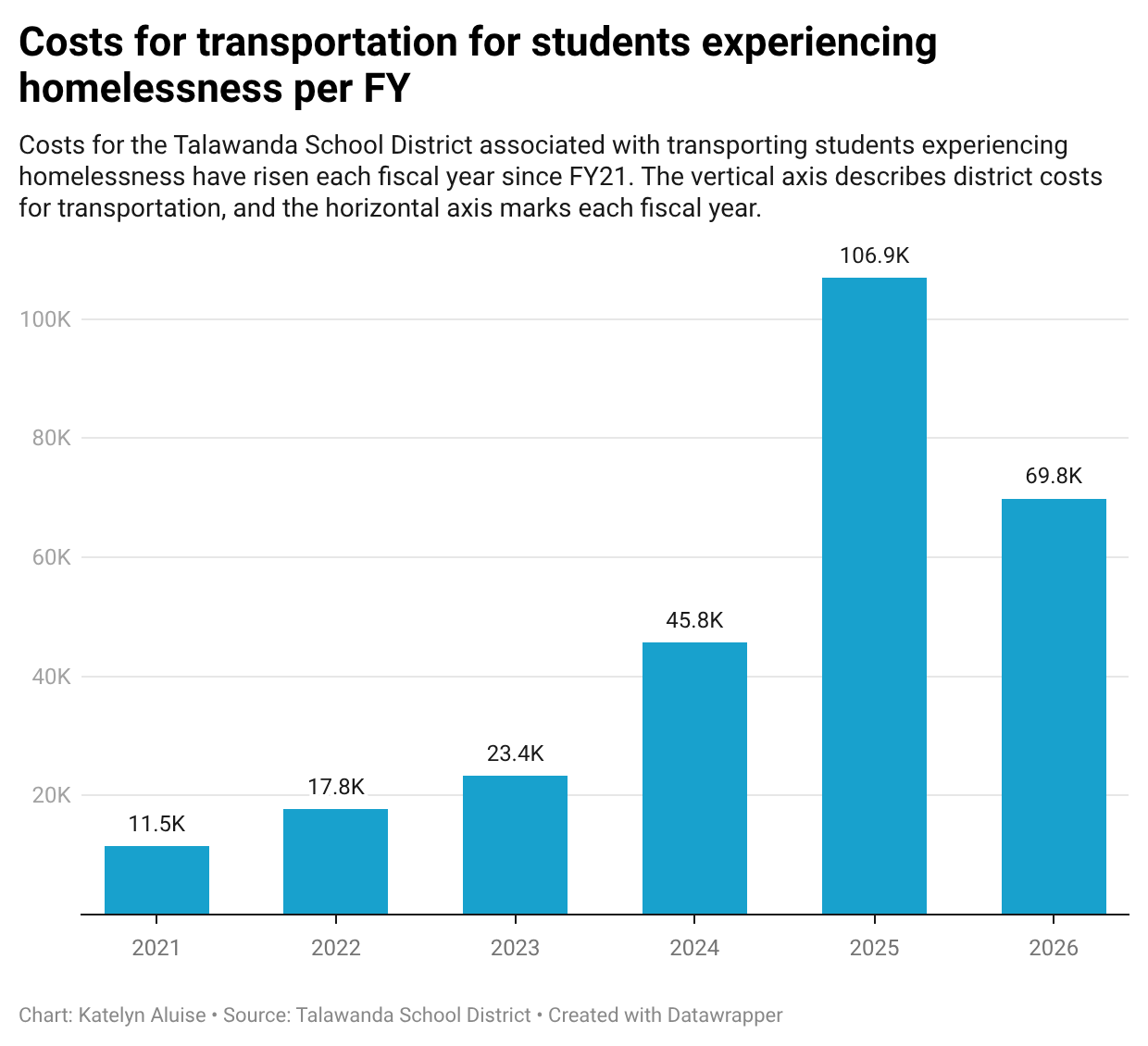
A series of budget summaries supplied by Tafelski showing each fiscal year of expenses related to providing transportation to students experiencing homelessness shows the total expenditures at $11,483.06 for FY21 and at $69,805.91 for FY26.
Although there’s been an increase in costs for transportation associated with students who are unhoused each year, the ledger shows an unexplained spike in costs during the 2024-25 academic year, or FY25, at $106,983.33.
Theroux said in an email to the Oxford Free Press, “The costs have gone up,” adding that transportation agencies like Universal Transportation Services, which the district formerly used, and EverDriven have increased in price “just like groceries.”
“Those agencies are transporting school children so they have to make sure their vehicles, drivers, and procedures follow state and federal laws,” Theroux said in the email. “This costs those agencies money which is passed to us at some point.”
Additionally, Theroux said in the email, “It is unfortunate that we (and in any school district) have families/students without housing. We also know that by keeping students in one district (as much as possible) keeps students in school, helps with attendance, and ensures consistency that these students are often not having in their lives.”
A new agreement with EverDriven approved by the board of education in June, effective July 1, places the cost of future trips for the district at $80.51 per trip of 12 miles, with additional fees for wait times, car seats and safety vests, wheelchair accommodations and other fees.