
Valentine’s Day Chocolate
"The consumption of chocolate originated in Latin America as a beverage around 4,000 years ago. The Spanish conquerors took chocolate back to Europe in the sixteenth century, adding sugar to make the drink less bitter."
Chocolate is synonymous with Valentine’s Day. It’s the day when people send messages of love with cards, flowers and chocolates.
The precursor of Valentine’s Day is thought to be an ancient Roman pagan festival called Lupercalia, which marked the arrival of springtime. In 496 C.E., Pope Gelasius converted Lupercalia into a Christian celebration honoring Saint Valentine, the name of several early Christian martyrs.
The holiday became associated with love during the Middle Ages. The oldest surviving valentine is said to be a poem written in 1415 by the Duke of Orleans to his wife while he was imprisoned in the Tower of London, following his capture at the Battle of Agincourt.
The association of Valentine’s Day with displays of love is a nineteenth century British creation. The Industrial Revolution, which began in the United Kingdom, made possible mass production of valentines, originally of lace, and then of paper in the 1840s. Gifts of flowers and chocolate were added to Valentine’s Day in mid-twentieth century, though given its mid-winter date, Valentine’s Day is not the easiest time of year to grow flowers sustainably.
The consumption of chocolate originated in Latin America as a beverage around 4,000 years ago. The Spanish conquerors took chocolate back to Europe in the sixteenth century, adding sugar to make the drink less bitter.
The word chocolate comes from the Nahuatl language, which is the formal term for the Aztec language. The final syllable means water or drink, but the origin of the first syllable is unclear, possibly from the Nahuatl word for bitter, beaten or simply cacao bean.
All sources credit the English company Cadbury with inventing the heart-shaped box filled with chocolates in 1861. John Cadbury founded the company in 1824 to sell drinking chocolate. Sons Richard and George took over the near-bankrupt company in 1861 and quickly made it profitable by focusing on chocolate candy, including the Valentine’s Day heart-shaped box.
Cadbury chocolates are still made in England, but the company was sold in 2010 to Kraft Foods. Cadbury is now a subsidiary of Mondelez International, a company spun off from Kraft in 2012.
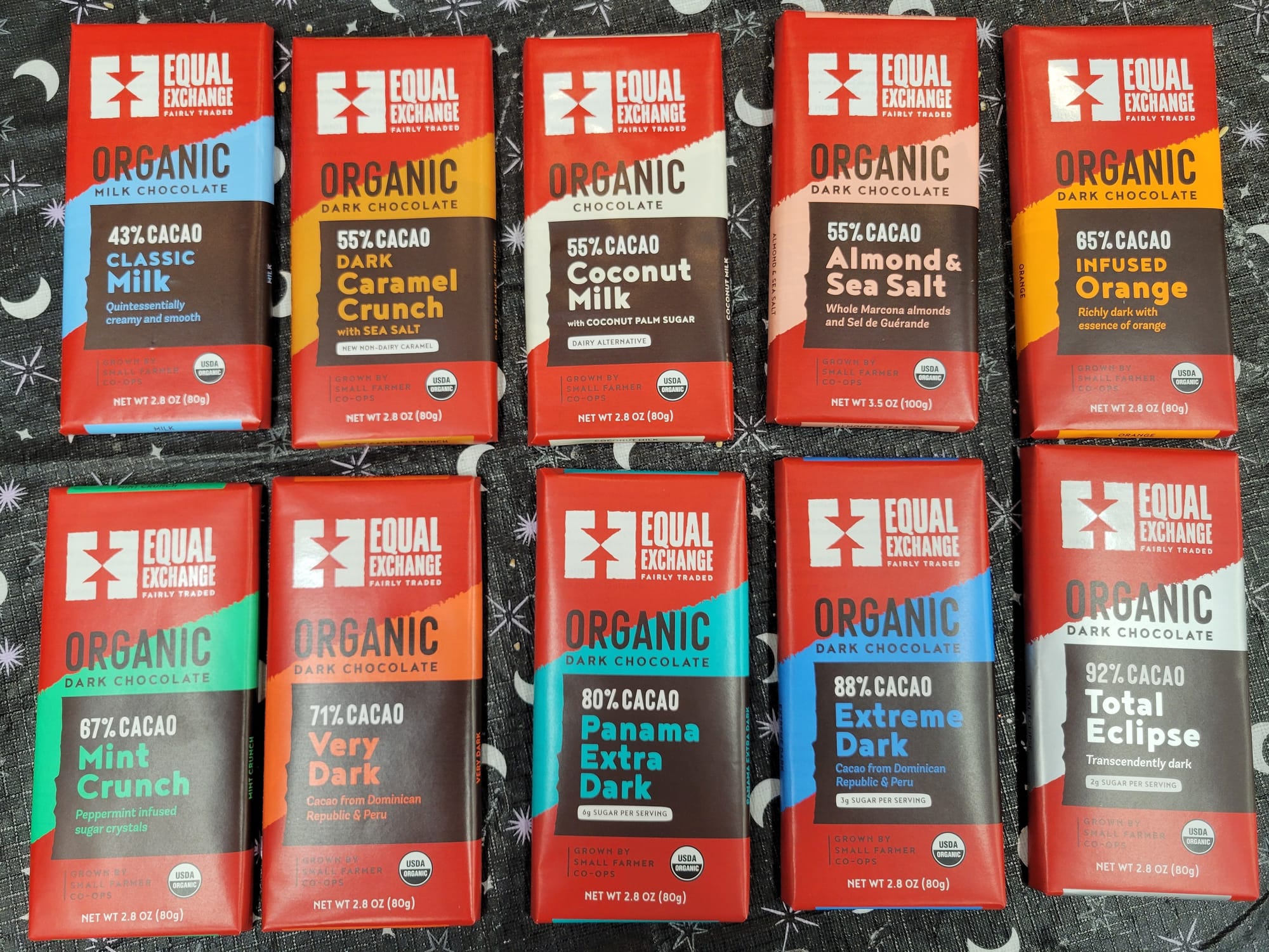
Chocolate is not exactly healthy food, but Certified Fair Trade and local options are more sustainable choices than mass-market candy.
MOON Co-op Grocery’s top-selling chocolate brand is Equal Exchange, which is a producer-owned co-op founded in Massachusetts in 1986 by Jonathan Rosenthal, Michael Rozyne and Rink Dickinson, all former managers of food co-op groceries (like MOON). Equal Exchange co-op in turn sources its cacao beans from grower-owned co-ops in Latin America.
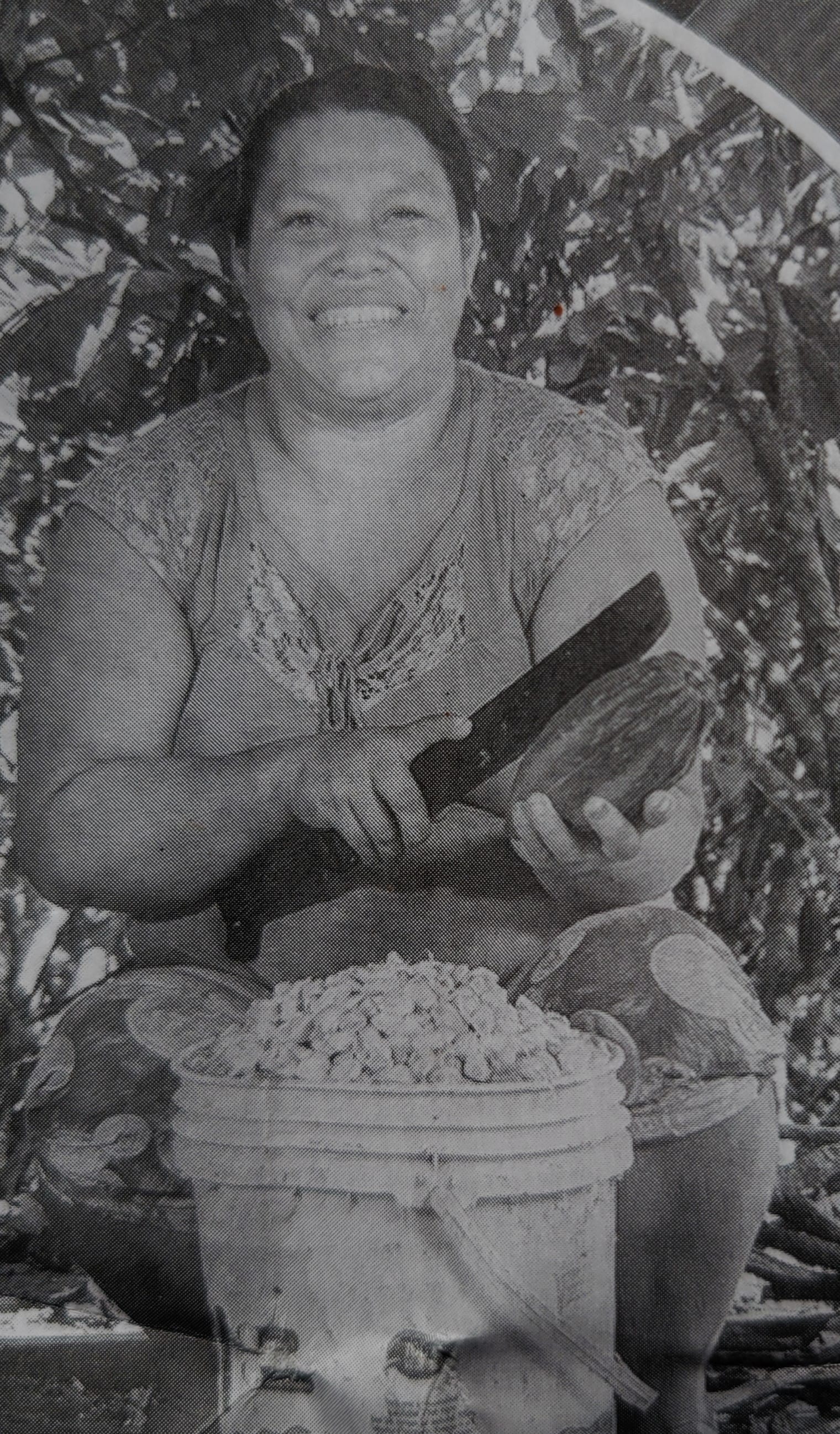
The inside wrapper of Equal Exchange bars profiles one of the grower-owner co-ops. For example, the wrapper for the Extreme Dark bar (88% cacao), which explains that the organic cacao in the bar came from a grower co-op called Oro Verde in Lamas, Peru, includes a photo of Oro Verde member-owner Orfith Satalaya Tapullima removing cacao beans from the pods.
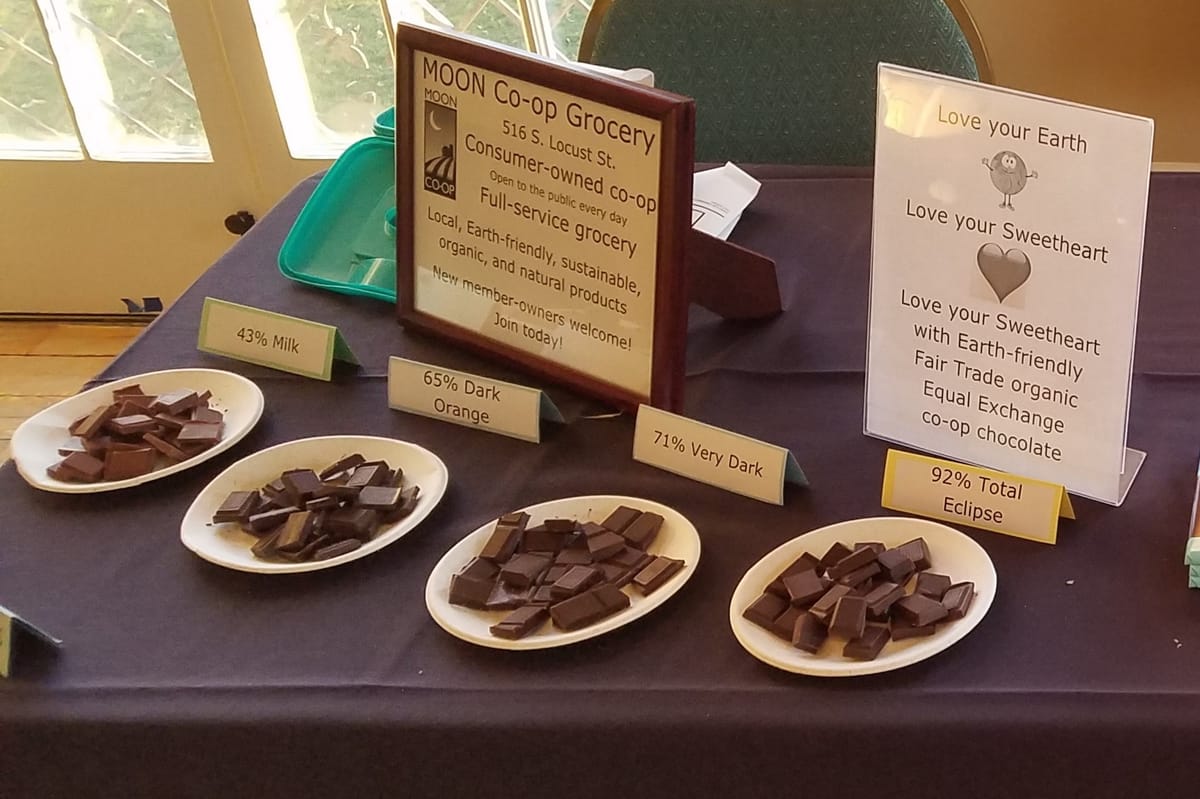
Equal Exchange helps underwrite MOON Co-op’s participation in Oxford’s annual Chocolate Meltdown. Eight varieties of the company’s chocolate bars were used at last month’s Chocolate Meltdown. The most popular variety this year was Orange, which contains 65% organic cacao beans, plus organic sugar cane, organic vanilla bean and orange flavoring.
Dark chocolate is more intense, but Americans prefer milk chocolate, which accounts for 85% of U.S. chocolate sales. Hershey’s milk chocolate bar contains only 11% cacao, whereas Equal Exchange’s Milk Chocolate is 43% cacao.
James Rubenstein is president of the Board of Directors for the Oxford Free Press and professor emeritus of geography at Miami University.