
How Talawanda High School offers college credit
"Taking CCP at THS gives (students) direct academic support from our faculty without sacrificing their high school experience”
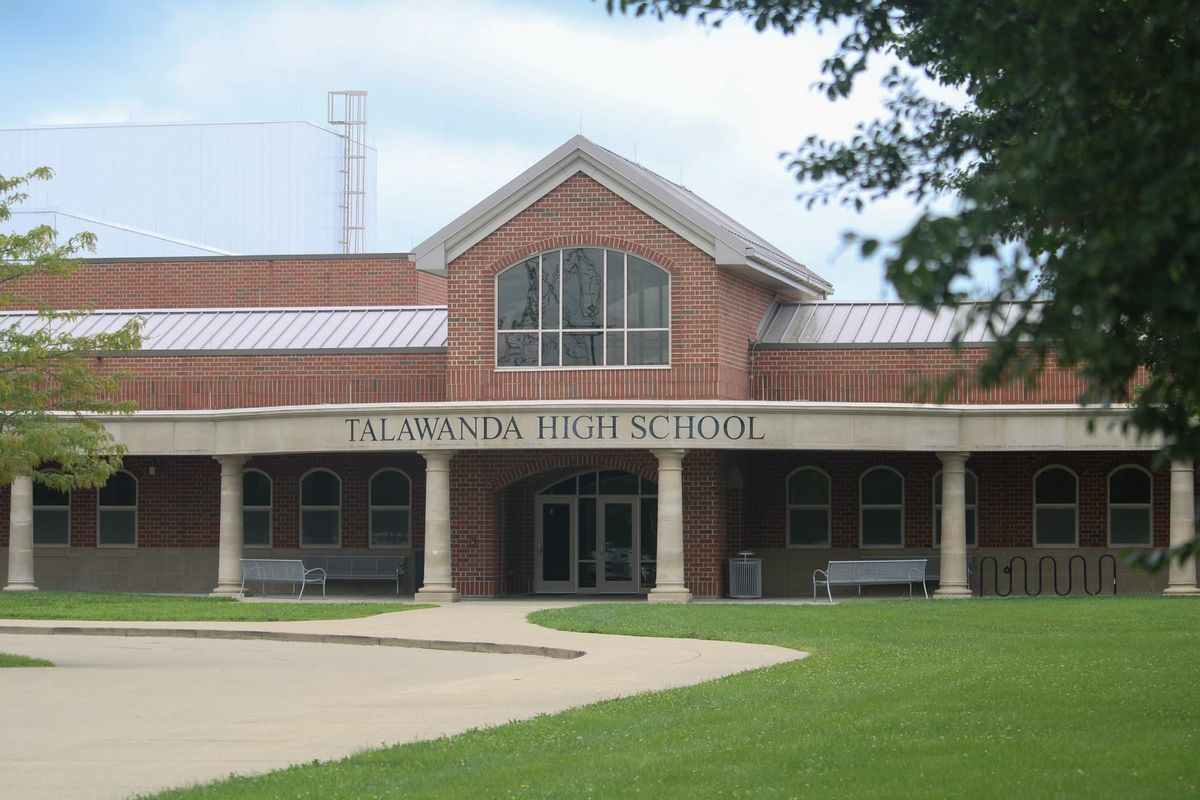
Talawanda High School (THS) offers classes that provide both high school and college credit, including College Credit Plus (CCP) and Advanced Placement (AP) classes
In recent years, the school district has increased its CCP offerings in an effort to allow students to gain college credit for free while still in high school.
CCP classes may be offered in-house or off-campus. An in-house CCP class is one taught on Talawanda’s campus by Talawanda teachers, but accredited through a partner college or university. Students also have the option to take off-campus CCP classes, usually at Miami University.
CCP classes operate like college classes, with credit being granted based on an A-F grading scale. These credits are guaranteed to transfer to public universities in Ohio, according to a Miami presentation.
AP classes are offered through the College Board and require a specific score on end-of-course exams to receive high school and college credit. Those who score lower receive only high school credit. According to the College Board, “Many U.S. colleges grant credit and/or advanced placement…for scores of 3 and above.”
In an email to the Oxford Free Press, Talawanda Superintendent Edward Theroux said, “For families, tuition for both CCP and AP coursework is provided at no cost. For the district, in-house CCP courses cost $42 per credit hour, whereas courses taken on a college campus cost $160 per credit hour. By law, Talawanda covers 100% of these fees regardless of the institution selected.”
However, AP exam costs are the responsibility of the student.
“Students pay the standard $95 exam fee for each AP test they choose to take … Students in an in-house CCP course can also elect to take the corresponding AP exam. This allows them to earn guaranteed college credit through CCP while simultaneously securing an AP exam score for out-of-state schools that may only accept AP credit,” Theroux said in the email.
This year, THS is offering 32 in-house CCP classes, an increase from previous years. They are also offering seven AP classes, which is the same as last year, though historically they have offered as many as 10 AP classes, Theroux said in the email.
According to Talawanda’s 2026-27 course scheduling guide, the in-house CCP class offerings this year cover a wide range of subjects, including science, social studies, math, English, foreign languages, agriculture, computer science and art and music history.
Many of these CCP classes fall within the Ohio Transfer 36 (OT36) curriculum, a standardized set of classes which “provides guaranteed transfer credit for a complete set or subset of general education requirements at an Ohio public college or university,” according to the Ohio Department of Higher Education’s website.
Kalinde Webb, a THS teacher who has taught in-house CCP English since the fall of 2019, said offering both AP and CCP classes allows students to take classes that interest them and fit their academic goals.
“What I love is that we’re offering kids a lot of choices …there are options for everyone. It’s not a one-size-fits-all for education,” Webb said.
Beginning in 2025, the English department has offered three new in-house CCP classes: “The Novel,” “Women Writers” and “Children’s Literature.”
Additionally, with the expansion of in-house CCP class offerings, fewer students are travelling off-campus during the school day.
In an email to the Free Press, Theroux wrote, “Enrollment in our in-house CCP classes has grown significantly as we’ve expanded dual-enrollment opportunities, while off-campus enrollment at outside institutions has decreased as part of these increased offerings.”
The district has seen an increase in student presence on Talawanda’s campus as a positive.
“Travel times often clash with our high school schedule, causing students to miss multiple periods,” Theroux wrote. “Traveling off-site can also make students feel disconnected from the high school experience, their friends, and extracurricular activities, particularly during their senior year.”
Theroux added in his email that “taking CCP at THS gives (students) direct academic support from our faculty without sacrificing their high school experience.”