
Local Legends: A mastery of masonry
"Burns was born to Richard and Delphina “Della” (Jones) Burns on Nov. 18, 1871 in Oxford."
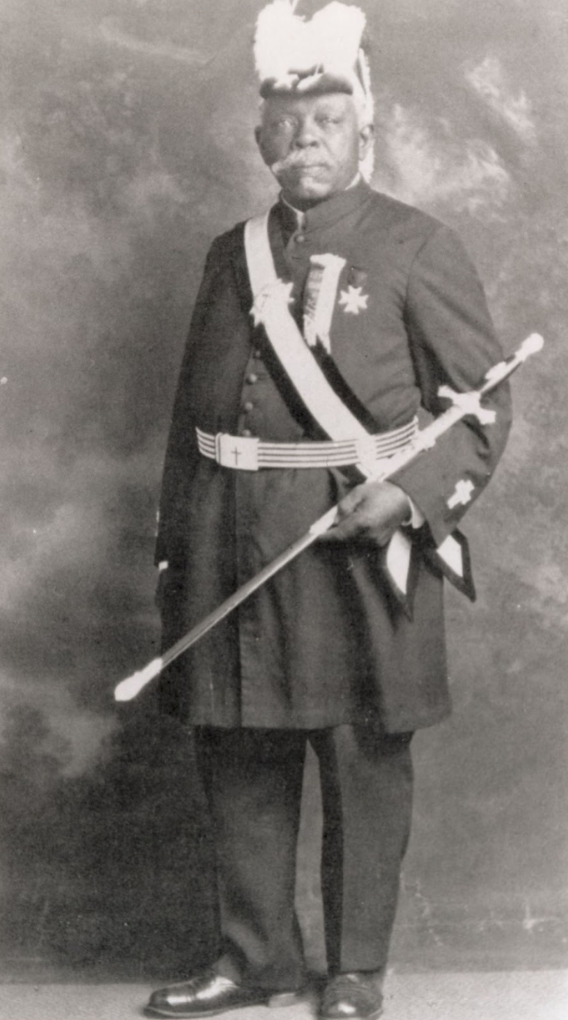
Not only was Cephas Ashler Burns a 33rd Degree Mason, but he was also a master stone mason renowned for his work in and around Oxford, especially on the Campus of Western College.
Burns was born to Richard and Delphina “Della” (Jones) Burns on Nov. 18, 1871 in Oxford. A free-Black northerner from Morning Sun, Burn’s father was a veteran of the American Civil War, having served at Nashville, Tennessee with the 9th United States Colored Heavy Artillery Regiment. He also served two terms on Oxford town council in the 1890s, only the second Black councilor in the town’s history.
In addition to his civic pursuits, Richard worked as a stonemason, giving his son an Aramaic word meaning “stone” for a name. With the name of “Cephas,” it seemed predetermined that Burns would grow up to follow his father’s professional footsteps.
Indeed, Burns grew up helping his father and learning the family trade. In 1892, Burns married Carrie (Bruner) Burns, daughter of another USCT Heavy Artillery veteran and Oxford resident, Peter Bruner. Carrie notably helped her father write his autobiography “A Slave’s Adventures Toward Freedom,” a memoir of growing up in slavery and serving with the Union Army.
Burns built them a family home at 310 N. Main St. in a northern section of Oxford heavily populated by Black families at the time. Together they raised a single child, Edna Naomi (Burns) Bradley, born on Oct. 5, 1896.
However, tragedy struck when Edna was just three years old when Carrie died at the young age of 30. With Burns working to support his family, Peter Bruner and Fannie (Proctor) Bruner, her maternal grandparents. Burns remarried on Sept. 14, 1905, wedding India Bell (Churchman) Burns.
Working with his father, Burns laid the foundation of Benton Hall on Miami University’s campus in 1907, a structure also worked on by Harry S. Thobe, Oxford’s other master stonemason. By this time, Burns’ skill outmatched his father’s who “marveled at his son’s innate talent.”
Notable as a perfectionist, Burns wasn’t interested in doing a project that was done precisely to his specifications. This included the use of specific “cannonball” stones that characterized his work. He often wandered through Four Mile Creek, Harker’s Run and Collin’s Run searching for and hand picking these specific native stones, rounded through erosion. When he built with the stones, he also insisted on not touching wet mortar for a month after to ensure its dryness.
This precision, consistency and attention to detail led to burns earning a reputation as a master stonemason. With this reputation preceding him, President William Waddell Boyd hired Burns to do masonry work on the Western College campus. He also subcontracted with builder Thomas Clark Lloyd from time to time.
The stone bridges on Western’s campus became the most significant examples of Burns’ work. With an all-Black crew of apprentices, Burns began replacing Western’s older wooden bridges in 1922. When the work ended in the early 1930s ten beautiful stone bridges stood on Western’s campus.
Along with the bridges, Burns also laid stone and oversaw work on sixteen cannonball stone lampposts and the gates leading to Patterson Place. Given the high level of skill he exhibited in his work, Western also hired him to build the Ernst Nature Theatre alongside James Jones, another Black stonemason from West Elkton.
Beyond these infrastructure projects, Burns also did work on buildings. This included the Grey Gables Cottage in 1913, the stone chimney of the Stillman-Kelley Studio in 1917, the stone facade of Kumler Chapel in 1918, a stone gazebo near Kumler Chapel, and the foundation and the chimney of the Western Lodge in 1926.
On a personal level, Burns loved books and reading, especially those of Herman Melville and William Shakespeare. He held a personal library composed of 175 books and acted as a librarian for his own collection, logging names of borrowers.
Burns was widowed for the second time on March 12, 1930 when India died from a chronic kidney disease at Longview State Hospital in Cincinnati where she had been a patient for the previous few days. The reason for her being an inpatient at Longview, which had previously operated as a state asylum, has been lost to history, but an article published prior to the death of Burn’s daughter and using information she contributed does detail the loneliness Burns felt after her passing.
Although responsible for much of the iconic stonework that defined the Western College campus, like many Black Americans, Burns encountered great difficulty in finding work with the onset of the Great Depression. Along with the loneliness he felt over the loss of his second wife, this was likely the impetus for his decision to take his own life on May 24, 1935. He was 63 years old and was buried in Woodside Cemetery where both of his wives had also been interred.
It was a devastating end for a man whose life had come to be defined by his work. While his artwork still graces Western’s campus, the home he built for his family, including its cannonball stone porch, was demolished in 2006.
Brad Spurlock is the manager of the Smith Library of Regional History and Cummins Local History Room, Lane Libraries. A certified archivist, Brad has over a decade of experience working with local history, maintaining archival collections and collaborating on community history projects. He also serves as a board member for Historic Hamilton Inc. and the Butler County Historical Society.
![[clockwise from top] Tatsoi, Tokyo Bekana and Komatsuma.](/content/images/size/w720/2026/02/01-5.jpg)