

Miami CIO cautions rising costs of AI, some professors working to expand access
“It’s pretty clear that we’re still not paying the full rate of what it’s costing to do the AI work … We just don’t know what is being hidden behind the scenes when we do that.”
As Miami University moves toward integrating artificial intelligence (AI) into its majors, offering an AI bachelor’s degree and continuing to provide access to Gemini and other assistance, Vice President for IT Services and Chief Information Officer David Seidl cautioned about the rising costs associated with AI’s “token economy.”
During a Finance and Audit Committee meeting of the Miami Board of Trustees in May, Seidl told members, “If you’re consuming data right now, AI is everywhere.” He asked them to not only be thinking about its cost impacts on Miami, but the entire supply chain.
Tokens are basic units of AI computation power, and it takes an arbitrary number of them to perform a task, Seidl said. Each of these tokens costs real money – a fraction of a cent – because it requires time and expenses to complete an AI query.
“If you say, ‘Help me rewrite this email,’ it’s going to be a much lower number of tokens,” Seidl said. “As you get into these high AI usage areas, for example people at Cursor (AI coding company) who are doing really technical work and they’re using a whole fleet of AIs to do the work … that’s how they’re spending $1,000 a day of tokens.”
Seidl told the committee, “Our students are going to be graduating into an economy where they are trying to leverage AI, and that spend is going to be real.”
Users requiring a higher level of tokens can purchase monthly token subscriptions that equate to a certain limit of tokens, or a limited AI computation power, per month.
Seidl told the Oxford Free Press, as models become more complex, “They will build themselves assignments and write themselves notes and do other things that then spend more tokens to do more complex work.”
He said there is an overall increasing demand for tokens as more AI work is being completed.
“This is the edge of a new economy that most of us are only seeing bits of, but that is driving a lot of cost into those organizations,” Seidl told the committee.
Miami spent roughly $140,000 this year on its overall suite of Google services that include Gemini, Seidl told the Oxford Free Press.
Seidl said he believes the original offering was 1,000 tokens per student per month. Now, he says Google counts “prompts,” each of which can use multiple tokens.
Students at Miami have unlimited access to the “fast” model of Gemini, 300 prompts per day of the “thinking” model and 25 prompts every four hours for the “pro” model, Seidl said. Each model is suited to different levels of complexity according to students’ prompts.
Seidl said he is beginning to get notifications from professors whose students are hitting the limits of their Gemini accounts, as more of their work or research requires more complex AI computation. As a result, he said some faculty members are beginning to look at commercial subscriptions for students.
For example, where a student in one class may be paying for a textbook, a student in a heavily AI-centered course may subscribe to Claude or another AI tool for a three- or four-month-long class.
Dennis Cheatham, an AI Provost Fellow and associate professor of graphic and experience design, said he personally has reached his limits with AI before and has set a limit on how much he’ll pay for Claude. He said he’s heard from other faculty that some of their students are hitting their limits.
Cheatham said, for most students, the prompt limits provided through Gemini is enough, although there are some more “extreme” cases. He said some students are also wanting to use AI tools like Fable, which is pay-per-use, although this is likely to be more prevalent in majors like engineering and business.
“Several faculty there have looked at how can we fund some tokens for students who want to use the Frontier models, those most advanced ones like Fable, or those who are pushing the limits of the high effort or the medium effort (tools) and doing a lot of use,” Cheatham said.
Cheatham said about the idea of increasing limits or tokens for students overall, “I haven't necessarily been advocating for it because right now it's a case by case scenario that probably is not a broad policy or a push, but it would be helpful to find ways for students who are using the tools at those highest levels and faculty to have some support.”
Seidl said he’s been told some professors, including ones in the Farmer School of Business, are looking at more ways to provide access to tokens or prompts.
“That’s one reason why we’re looking at ways to provide broader access to not only more tokens … but also a broader set of AI tools,” Seidl said of IT Services, adding students and staff are also learning to be more “nuanced” with the AI tools they’re using.
When the Oxford Free Press asked what providing broader access means and if Miami might have to spend more to afford students more tokens or prompts in the future, Seidl said, “we’re talking about how we do that in a reasonable way.”
“What you don’t want to have is some very heavy users who completely break your budget, but you do want to make sure that you’re providing the tools for students and faculty and staff to be successful in their roles in reasonable ways,” Seidl said. “And if they have exceptional needs that are justifiable, you need a path to be able to get them there.”
Right now, Seidl said there’s a broad range of what institutions are willing to pay per student. But as Miami explores what it’s providing, Seidl said he’s concerned nobody is paying the “true cost” for AI models as the programs are still relatively new.
He said everyone may soon be in for a “rude awakening” if companies begin charging what it really costs them to run an AI.
“It’s pretty clear that we’re still not paying the full rate of what it’s costing to do the AI work,” Seidl said. “We just don’t know what is being hidden behind the scenes when we do that.”
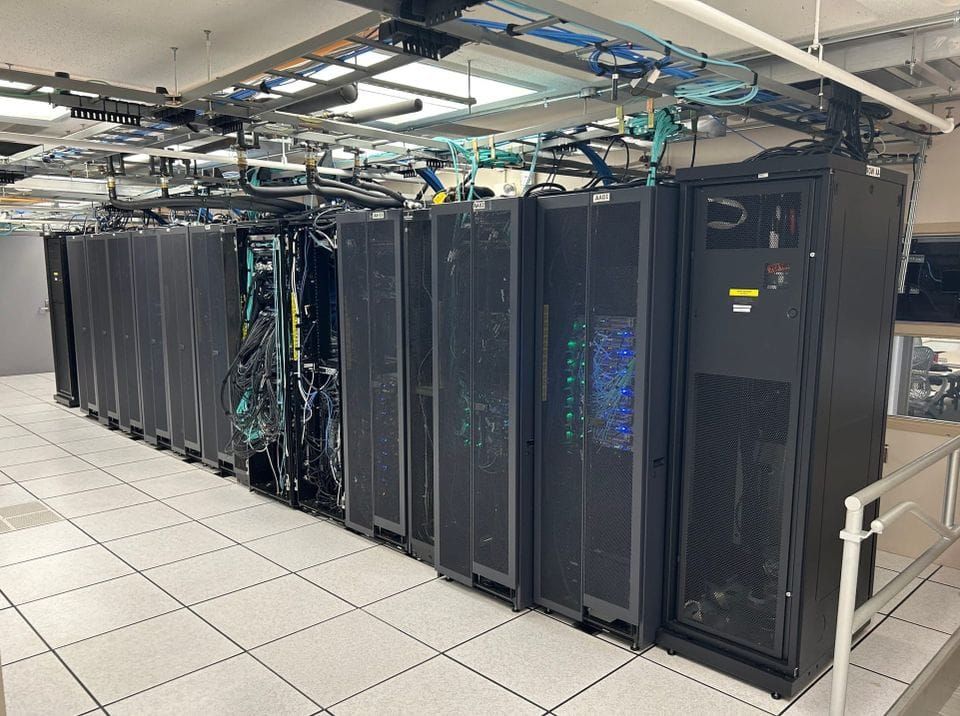
Seidl said the data center Miami’s IT department has been working on in Hoyt Hall may also be able to help with computational power a little in the future. But he said part of learning how to use AI is also learning how to be efficient and thoughtful about how it’s being used.
Cheatham said there are faculty in Miami’s Department of Emerging Technology in Business and Design who are currently exploring ways to run AI locally, such as on a computer, so they’re not pinging a data center and are using less natural resources.
Ultimately, Seidl said it’s the university’s goal to ensure a baseline capability for its students, much like it provides Microsoft Office, Google apps and internet connectivity.
“The world has changed, whether we want it to or not, and AI is, in some form, here to stay for the foreseeable future, from my perspective,” Seidl said. “And from an institutional perspective, our job is to prepare students for the world that they will go into to be successful and to equip them as fully as we can.”



David Seidl, vice president for IT Services at Miami University and chief information officer. Jay Shan, associate professor of information systems and director of AI initiatives in the Farmer School of Business. Fadel Megahed, professor of information systems and business analytics in the Farmer School of Business. Photos courtesy of Miami University.
Expanding access
Fadel Megahed, professor of information systems and business analytics, is the co-creator and maintainer of an AI tool called ChatISA (information systems and analytics) that was released in Miami’s Farmer School of Business on Nov. 30, 2022.
The idea for the tool was started when Megahed was talking with one of his colleagues about how to provide more equitable access to AI tools for students who may not otherwise be able to afford various subscription services. Megahed worked with other faculty, researchers and other universities to create ChatISA.
In 2024, Megahed and six other Miami researchers published a paper about the resource titled, “ChatISA: A Prompt-Engineered, In-House Multi-Modal Generative AI Chatbot for Information Systems Education.”
The group created an AI chatbot interface with, among other functions, the ability to run code and connect to three major AI providers through code: OpenAI, Cloud and Gemini.
Currently, Megahed said the monthly bill for students using ChatISA is around $300 to $400. He said there are currently no per-student limits to using ChatISA, and the monthly charges are for the different AI providers, which is supported by a technology gift by the U.S. Bank, Miami’s ISA department and the Farmer School of Business.
In Megahed’s department, which teaches roughly 500 students, he said a minimum of 150 to 200 students are getting exposed to ChatISA each year.
He said ChatISA has privacy guardrails which are unique from other AI platforms, because the interface itself is not using students’ data to train AI models.
Within ChatISA, students have access to a coding studio where they can work on their homework, a coding tutor that can help them along the way, an exam prep tool and a project assistant. Students also have access to an AI job scout tool, an interview mentor that can help them learn how to answer questions and a portfolio creator tool.
Because ChatISA was created by Miami researchers, Megahed said they were able to give it context for how coding is done in Miami classes and to – instead of giving students the answers – help them understand how the code is generated.
“It tends to, by default, ask more questions than just throwing an answer at the student,” Megahed said. “There is … a more natural way for the students to to learn how they reach the answer.”
Jay Shan, associate professor of information systems and director of AI initiatives in the Farmer School of Business, said there’s a department-wide effort to create an “AI gateway.” He said this gateway could be connected to different AI models or could be an open-source model that uses a university server and potentially lowers the cost of using it.
He said the gateway would also potentially enable students to access more advanced AI tools without students needing to pay for their own subscriptions, which would be a more efficient use of AI as everyone shares a pool of tokens.
Although he said the future resource doesn’t have an official name yet, and he doesn’t have an exact timeline on the project, he said his department is relying heavily on the IT department, which is currently working to make it available.
“This kind of gateway has a very wide usage,” Shan said. “It can support our research, support our teaching, support both the faculty and the students. So (there are) definitely a couple of initiatives we are currently working with David's team … and most important is to come up with some budget information and see how much we can implement as soon as possible.”
Shan said his students aren’t only using Gemini, but they’re also coming back from their summer internships where they were using more advanced tools and trying to replicate that work in the classroom. Shan said his department is trying to figure out how to support these students right now by giving them access to more advanced token subscriptions.
Shan said his department already has some grant funding, which the dean can decide whether or not to use to purchase subscriptions.
“We are also in a learning process to figure out how (we can) support students, but at the same time with some reasonable cap,” Shan said.
He said there have been department-wide conversations about the misuse of AI and how to reinforce the correct ways to use it. It’s clear, he said, that employers want students to have basic AI skills, while also having the ability to problem-solve independently.
“We clearly believe that (AI) will be part of our future life and future jobs. This is a trend that no one can resist,” Shan said. “What we need to do is just figure out a new way to support our students to adapt to this new norm.”