
Miami IT looks to expand sustainability efforts with existing on-campus data center
David Seidl said while he will not be able to provide all members of the university with all the AI they can consume from the Hoyt Hall data center, he can make a “baseline amount” available for those who are using it while focusing on efficiency.
As Miami University prepares to integrate teachings about artificial intelligence (AI) into all of its academic departments’ curricula, the information technology department is looking into ways to expand the capabilities of an on-campus data center to continue promoting Miami’s mission of sustainability.
The Miami Board of Trustees endorsed the “AI in the Majors” initiative during its meeting on May 15. This initiative began at the start of the 2026 spring semester when 13 academic departments volunteered to be first to research the impacts of AI in their fields and eventually introduce those topics into their curricula.
Miami students and faculty have access to Google Gemini Chat, Zoom AI Companion and Webex AI Assistant with their Miami credentials, and some faculty are already researching AI, teaching students about its uses or using it themselves.
By the 2027 fall semester, all Miami departments will have implemented teachings about AI into their curricula.
The data center
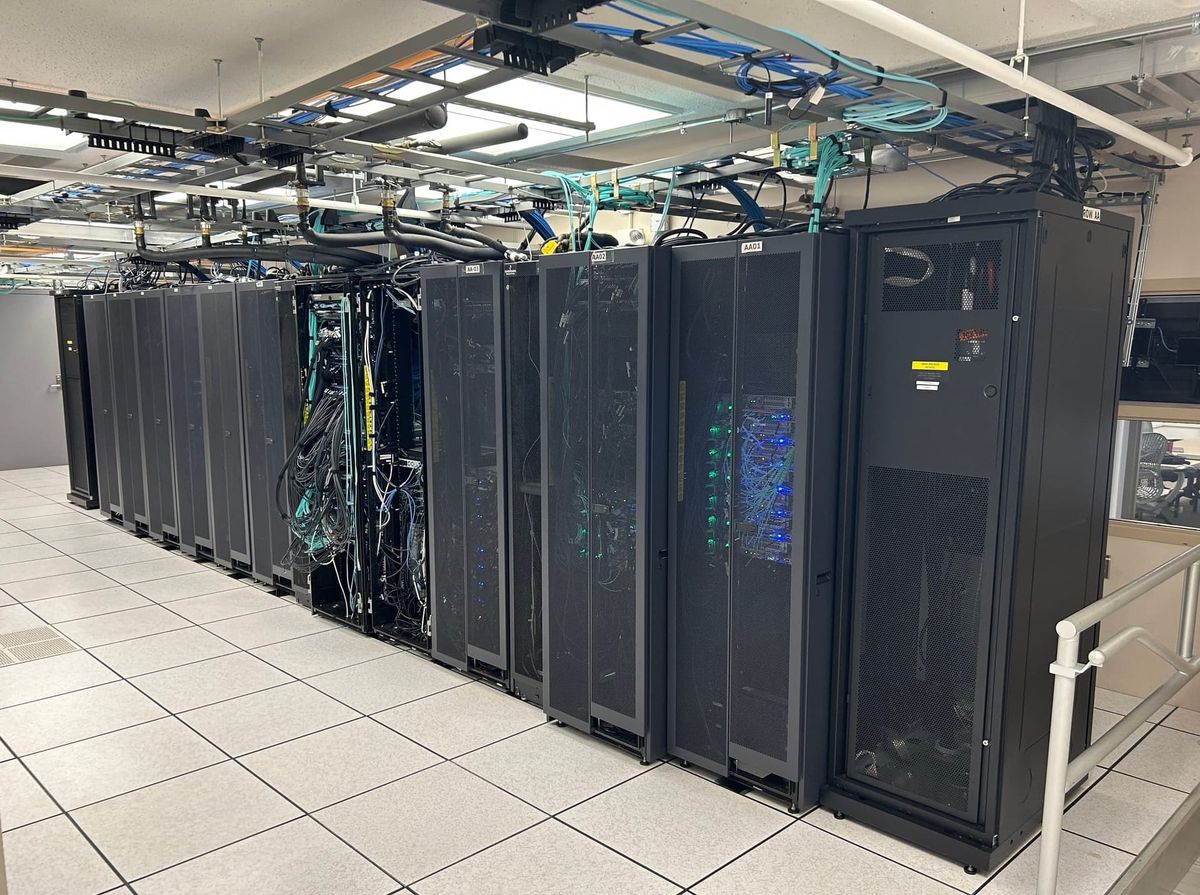
Located on the lower level of Hoyt Hall is a data center, through which a graphics processing unit (GPU) supports AI and other research, according to David Seidl, vice president for IT services and chief information officer.
The conversations about installing the data center started over two years ago, and the university received a Campus Cyberinfrastructure (CC*) grant from the National Science Foundation for nearly $500,000 with a project start date of May 2024.
Seidl also announced during a Miami Finance and Audit Committee meeting on May 14 that his department has collaborated with other staff at Miami to put together over $3.8 million worth of proposals for AI research grants this year and will continue to write proposals.
The data center, Seidl told the Oxford Free Press, is a relatively high-power system that’s connected to Miami’s geothermal grid.
Miami’s geothermal wells, located below the Sharon and Graham Mitchell Sustainability Park at Miami and beneath the front lawn of Millett Hall, work by storing heat in the ground that’s released by buildings on campus in the summer while they’re being cooled. This heat is then reused to warm the buildings during the winter.
Since the geothermal wells in front of Millett Hall, called the North Chiller Plant, were brought online in April, Miami now has one of, if not the, nation’s largest geothermal systems on a college campus, Olivia Herron, director of sustainability, said.
In an email to the Oxford Free Press, Herron said using the geothermal wells poses significant water savings for the university compared to cooling towers, which evaporate water to cool campus buildings.
Herron said although there’s an estimated 176,000 gallons of water circulating through the new well field, the university is estimating a 43% reduction in water use to heat and cool campus facilities using the North Chiller Plant, or almost 20 million gallons of water annually.
Additionally, the university operates closed-loop geothermal systems, meaning the same water pumped into the wellfield to begin operation will continue to be in use as the system remains online.
Seidl said of the use of the geothermal system to support the data center, “When we do AI computation and research computation, that’s actually a net benefit to the geothermal grid because we’re heating water by doing computing rather than using a boiler.”
Instead of the waste heat from the data center being plumbed into the outside world, it’s sent to the geothermal array to be used on campus.
Seidl said his department is watching how vendors are working towards more efficiency for AI use and is “encouraged that more efficient models are coming, and we’re seeing less power usage for AI.”
As faculty members use Gemini, OpenAI, Claude or other tools, Seidl said those queries are typically being processed outside campus at other major data centers. However, when faculty members are completing research computing, this is processed at the on-campus data center.
“We’re starting to look at whether we can go local, high efficiency, self-managed LLMs (large language models), so that we could run some of those models in the data center and give people access,” Seidl said.
LLMs work by processing text datasets, summarizing them and generating text responses. For example, ChatGPT is built on top of an LLM.
“That would be using our geothermal, solar and that kind of offset,” Seidl said. “We’re not there yet, but we’re working on figuring it out. … (We’re) expanding this data center’s capabilities and also allowing our faculty, students and staff to use local AI as opposed to Cloud AI.”
Seidl said while he will not be able to provide all members of the university with all the AI they can consume from the Hoyt Hall data center, he can make a “baseline amount” available for those who are using it while focusing on efficiency.
“It is providing choices and then providing people with an understanding of the decisions that they're making as much as they can,” Seidl said. “Like if you go around campus and look at the recycling bins that say, ‘Hey, throw recycling here,’ that’s a nudge. I think we’ll have some nudges around AI usage.”
Right now, Seidl said his department is putting in the first round of “compute” for the Hoyt Hall data center to be used for general purposes directed toward research computing. He said the university even contributes some of its capabilities to the National Open Science Grid.
Next fall, Seidl said the university will hopefully learn the consumption rate of AI use on campus so his department can gauge how the data center's capabilities need to be expanded.
“We should have a pretty good handle by December on what our use rate is,” Seidl said. “I expect that to continue to grow. And so I think it's going to be: we learn, it grows.”
Seidl said he believes the data center may have two years' worth of expansion capability, or three if it stays at its current growth rate. As of now, he said staff have already doubled the infrastructure of the data center from what was installed in the first 12 months.
Seidl said the data center will have 12 H200 graphics cards available for compute once it's running with an LLM, and depending on the complexity of what someone uses AI for, he expects it will be able to handle tens to hundreds of people using it simultaneously.
Seidl said the university is hoping to pick a subset of open-source LLMs to make available for use that will be processed through the Hoyt Hall data center. An open-source LLM is one that is free for anyone to download and run locally without relying on a provider like Google. An example of an open-source LLM is Llama, which was developed by Meta.
Seidl announced during the May 14 meeting that the IT department released its AI director position for recruiting among existing faculty, and the position should be filled by the fall.
Two AI provosts, Dennis Cheatham and Heidi McKee, were previously hired to research how faculty and students are engaging with AI, as well as the concerns they have or challenges they’re facing.
AI cost, security concerns
Part of Seidl’s work is also in cybersecurity for Miami students and faculty.
While AI use expands at the university, Seidl consistently reminds people to only use AI tools for Miami work that Miami has signed a license with AI vendors for instead of free tools. He also reminds people not to feed AI any information that should be kept private or protected.
“People should think about what they are using and be cautious about what they put into AI the same way they should be cautious about any data that they’re putting into something on the internet, and always remember to check what AI is doing,” Seidl said.
During the May 14 meeting, Seidl also discussed with the committee the “token economy” surrounding AI, wherein digital “tokens” must be purchased to complete queries or tasks asked of AI.
“It will not surprise any of you that we do not have $1,000 per student per day to spend on token availability for Miami, so we're thinking about how to continue to provide more AI access,” Seidl said.
Seidl said this “new economy” is driving a lot of cost into organizations that have high AI usage.
“We're using what we have in our data center. We're working with Google, which provides our Gemini AI, but we're starting to see where token limitations are actually hitting our students with what we're able to allocate them, and we're looking at ways for the fall (semester) to be able to give them more access,” Seidl said.