
Observations: Barney Frank
I knew Barney personally in my senior year in college. He was a graduate student then... We always sat together and Barney always talked, usually about politics in a fascinating way.
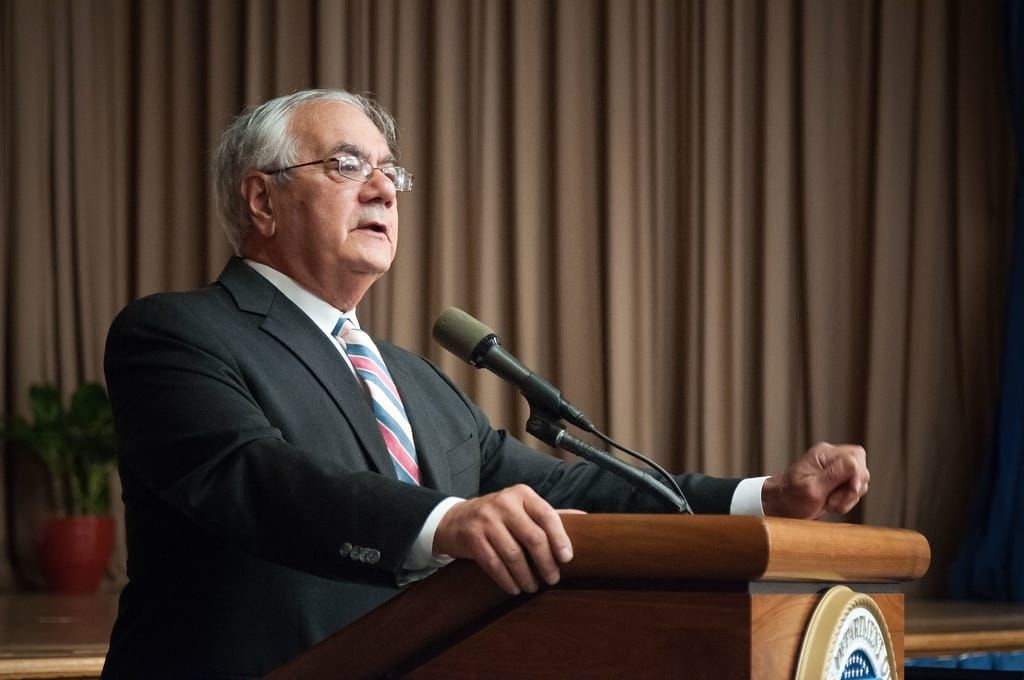
Recently, I’ve been thinking a lot about Barney Frank. Barney was a Democratic member of the House of Representatives from Massachusetts who died a couple of weeks ago. He was a colorful figure, but was also one of the most argumentative and influential members of the House – and he was a friend.
Barney was a Jewish Zionist, raised in Bayonne, New Jersey, where his mother was a legal secretary in New York and his father ran a truck stop, sometimes frequented by unsavory characters..
“Because Bayonne was such a sleazy place, nobody knew whether Barney was going to wind up in Congress or in jail,” noted lawyer Alan Dershowitz told The New Yorker in 2009.
Barney went to Harvard, worked for Freedom Summer in Mississippi in 1964, and later went to graduate school at Harvard to work toward a PhD. But he was always intrigued with electoral politics and ended up serving in the Massachusetts House of Representatives from 1973-1981, and then being elected to Congress, where he served until 2013.
Barney fought with Republican Speaker of the House Newt Gingrich when Republicans gained control in 1994. He defended President Bill Clinton during his impeachment trial. But, he was best known for what was known as the Dodd-Frank Bill, co-written by him and Senator Chris Dodd of Connecticut. This measure, which came in the wake of a devastating financial crisis, established many oversight mechanisms for the finance industry and introduced a number of consumer protections. It was a major step forward, though it is being eroded today.
I knew Barney personally in my senior year in college. He was a graduate student then, affiliated with Winthrop House – where I lived – and we were about the only people who got up at 7 a.m. to have breakfast in the dining room. We always sat together and Barney always talked, usually about politics in a fascinating way.
Barney recognized that there were good Republicans. Some of them were his friends, but he counseled against voting for them – for what was most important was a majority to allow his party to control Congress.
We played softball together on our Winthrop House intramural team. Barney was a pretty decent shortstop, while I played second base. At Thanksgiving in 1965, I drove Barney down to Bayonne so he could celebrate the holiday with his family. The car was full, with one of my roommates, a cousin of mine from Boston University and another classmate from my home town. Barney talked nonstop. We all interjected from time to time, but Barney was on a roll. And by the time we reached New Jersey, we were all exhausted.
Barney didn’t come out as gay until he had been in Washington for a time. And, to his credit, he was one of the first openly gay men in the Congress. As the father of a gay son, I applauded his decency, honesty and courage. He was embroiled in a scandal when his boyfriend at the time ran an escort service from their apartment. Barney acknowledged what had happened, said he was wrong and was reelected by his constituents in the next election.
I had hoped to visit Barney, who was living in Ogunquit, Maine, with his husband, when I went to Maine this summer, but he died too soon. Though he is gone, I will always remember him as a monumental character, and I will always recall him with affection.
Allan M. Winkler is a University Distinguished Professor of History Emeritus at Miami University, where he taught for three decades. He serves on the Board of Directors for the Oxford Free Press.