
On My Plate: Broccoli
Broccoli in our local supermarkets will have lost at least 75% of its nutritional value, according to Robinson, because they have been shipped here from California, where 90% of U.S. broccoli is grown.
“I do not like broccoli and I haven't liked it since I was a little kid and my mother made me eat it,” declared George H.W. Bush at a 1990 press conference. “And I’m President of the United States, and I'm not going to eat any more broccoli.”
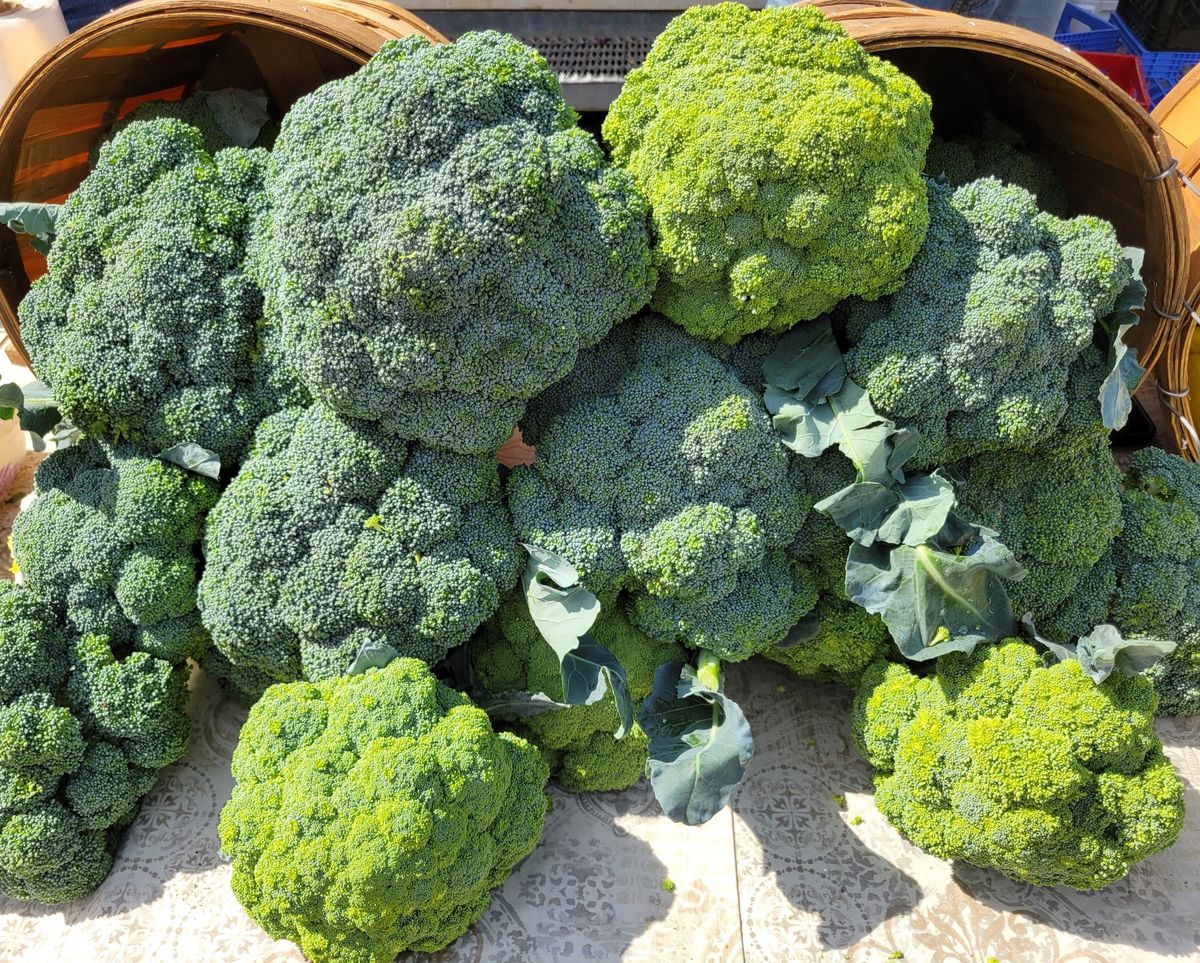
Broccoli has been the visual star recently at the Oxford Farmers Market. Downing Fruit Farm’s expansive broccoli display could be mistaken for showy flowers. Scott Downing identifies his two varieties as emperor and millennium. At the next farmer’s market table, Jennifer Bayne identifies her variety as simply “broccoli.”
Broccoli was engineered 2,000 years ago by Etruscan farmers (in modern-day Tuscany), who bred wild cabbage to emphasize edible buds and flowering crests. The word broccoli comes from the Italian plural of “broccolo,” which means “cabbage sprouts,” according to the Oxford English Dictionary. The vegetable was much prized in ancient Rome.
Drusus Julius Caesar, son of the Roman Emperor Tiberius, is claimed by internet sources to have consumed nothing but broccoli for an entire month because he was obsessed with its health benefits. That was not a recipe for longevity, however, because he died suddenly on Sept. 14 in the year 23 C.E. Ancient Roman historians Tacitus and Suetonius wrote that Drusus was poisoned by agents of Lucius Aelius Sejanus, prefect of the Praetorian Guard, who was having an affair with Drusus’s wife.
Returning the narrative to broccoli, Jo Robinson wrote in “Eating on the Wild Side,” “More than any other vegetable, broccoli has come to epitomize health itself.” Sally Fallon in “Nourishing Traditions” made the same point with less flourish: “Broccoli tops the list of common vegetables for nutrient content.”
“Few people get to benefit from those nutrients,” Robinson warned, “because these compounds are used up soon after harvest.” Robinson explained that “broccoli continues to respire after it’s been picked, but it does so at a very fast rate; it pants rather than breathes. Within a week’s time, this heavy breathing can destroy its most beneficial nutrients.”
Broccoli in our local supermarkets will have lost at least 75% of its nutritional value, according to Robinson, because they have been shipped here from California, where 90% of U.S. broccoli is grown.
My father would eat broccoli raw, but he refused to let any brassica be cooked in our house because of the smell. In one respect, he was prescient: raw broccoli is more nutritious than most forms of cooked broccoli. Cooking broccoli in water – either in a pot on the stove or in a bowl in the microwave – results in the leaching of a large share of the nutrients. The best way to cook broccoli is to bake or sauté it in olive oil.
The stem is especially prized when eating raw broccoli. It can be cut into strips for dipping in hummus. Some trimming of the stem may be necessary, although local broccoli needs less peeling than the older supermarket varieties.
The Royal Horticultural Society (RHS) website’s Fascinating Facts shares that a survey commissioned by Diabetes UK has identified broccoli as the U.K.’s favorite vegetable.
“And rightly so,” RHS notes “For not only is it delicious to eat, it’s incredibly good for you.” In the United States, opinion is divided, as with so much in these polarized times.
History has not recorded whether pro-broccoli voters cost President Bush his re-election bid in 1992. However, Americans may now be agreeing with him, because U.S. broccoli production has declined by 50% during the past decade, according to U.S. Department of Agriculture statistics.
James Rubenstein is president of the Board of Directors for the Oxford Free Press and professor emeritus of geography at Miami University.