
On My Plate: Pecans
"Pecans were first cultivated in North America in the 1770s. Both George Washington and Thomas Jefferson had pecan trees on their farms in Virginia."
The Myaamia Nation, officially recognized by the U.S. government as the Miami Tribe of Oklahoma, needs no introduction in Oxford. Myammia’s role in the history of our community and university has been increasingly recognized in recent years. Students and staff come here from Oklahoma, and university students and staff have tried to help out in Myaamia’s Oklahoma territory.
MOON Co-op Grocery, which is committed to offering local and earth-friendly food, has looked for a way to make a small contribution to honor Oxford’s connection to the Myaamia Nation. The store carries Tapaahsia Farm soap and other personal care items, made by Karen Baldwin on her family’s farm outside of Oxford. “Tapaahsia” is a Myaamia word meaning “goose.”
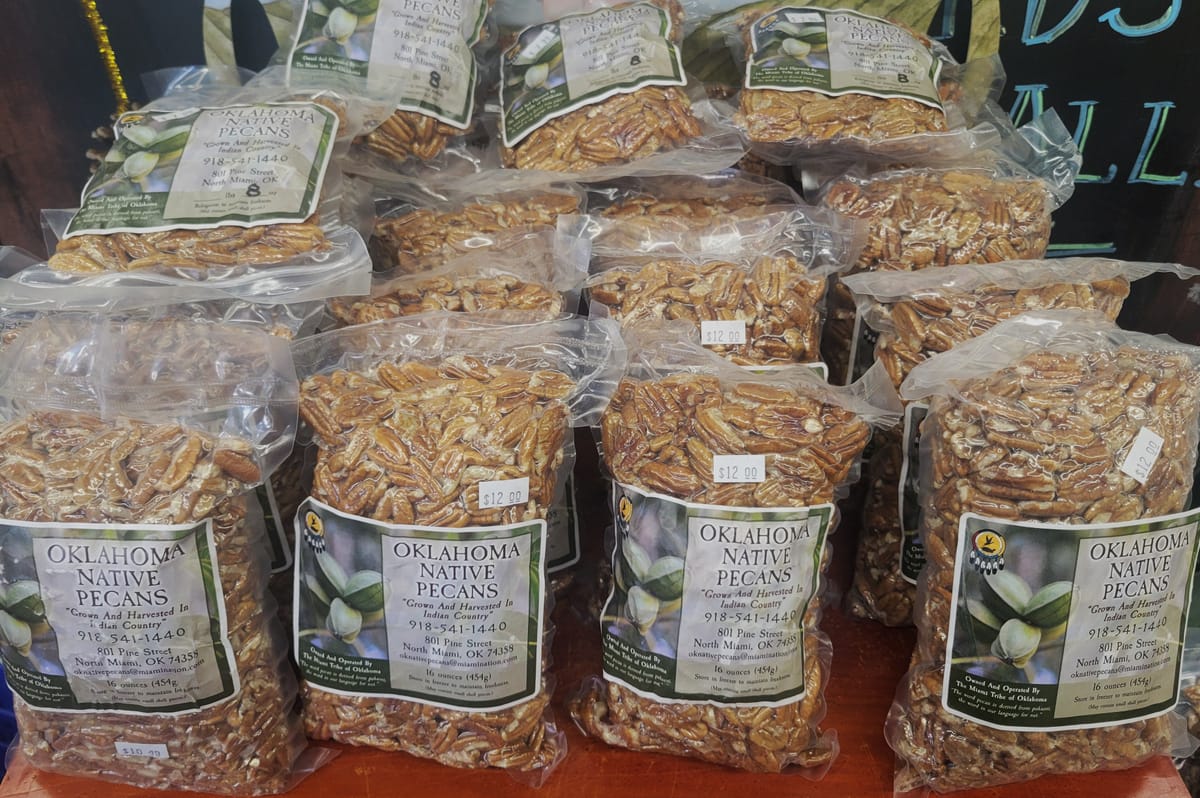
For some time, co-op staff have been looking for grocery items supported by the Myaamia Nation. A couple of months ago, success was achieved – the Miami Tribe of Oklahoma harvests and sells pecans, which MOON Co-op now stocks, at least during harvest season.
Pecans are the only major tree nut native to North America, serving as an important food source for thousands of years by indigenous populations in what is now the U.S. South as well as Mexico. Pecans supply calcium, magnesium, potassium and monounsaturated fat.
Today, the United States and Mexico account for more than 90% of the world’s pecan production. Pecan trees flourish across New Mexico, Oklahoma and Texas. Within Oklahoma, pecan country runs from the northeast corner southwest through the center of the state. Ottawa County, where the Miami Tribe is located, is Oklahoma’s third-leading county for pecan production.
My friend Pam Newell told me that pecan trees were common where she grew up in a relatively dry part of Texas. The nuts that fell to the ground were easily shelled and eaten on the spot. Indigenous people had already discovered that pecans were easier to shell than other nuts.
We regard pecan as a nut, but botanically it is a drupe, which is a fruit with a fleshy husk wrapped around a hard shell. Drupes, which include walnuts and almonds as well as pecans, split open when they ripen, whereas “true” nuts like acorns and chestnuts do not.
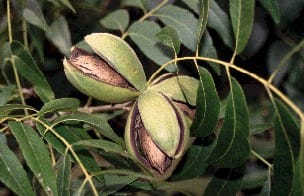
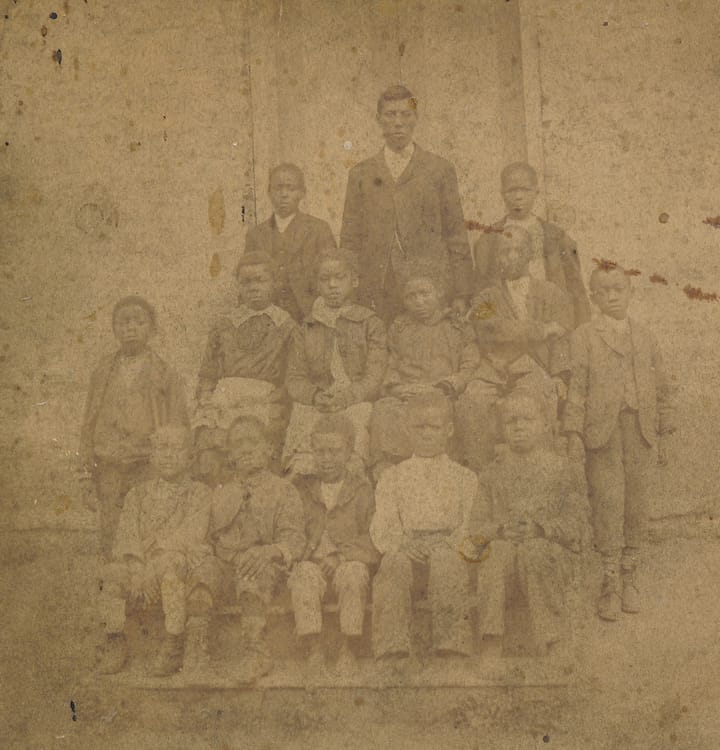
Pecans were first cultivated in North America in the 1770s. Both George Washington and Thomas Jefferson had pecan trees on their farms in Virginia. However, credit for the “modern” cultivated pecan is held by a man named Antoine, who had been enslaved in Louisiana. In 1876, Antoine, no longer enslaved, successfully propagated pecans by grafting a superior wild pecan to seedling pecan stocks. Antoine’s clone was named “Centennial” because it won the Best Pecan award at the 1876 Centennial International Exhibition in Philadelphia.
Thanks to cultivation, Georgia has taken over leadership in pecan production, accounting for one-third of the national output. Trucks bring Georgia pecans to Butler County several times a year, along with citrus and peaches.
The word “pecan” is considered to have originated from the Algonquin word “pakan,” which meant “a nut requiring a stone to crack.” The word was modified to “pacane” under the French language influence in Louisiana, before the anglicization to our “pecan.”
Pronouncing “pecan” stirs up trouble in some parts of the country. According to the National Pecan Shellers Association (www.ilovepecans.org), “PEE-kahn” is used by 70% of northerners and 45% of southerners, and is the first choice of Merriam-Webster Dictionary, but “puh-KAHN” has strong and vocal loyalties in the South, and “PEE-can” also has its supporters. The association refuses to express a preference.
James Rubenstein is president of the Board of Directors for the Oxford Free Press and professor emeritus of geography at Miami University.