
On My Plate: Scapes
My buddy John asked me for a favor: Could I get some local scapes for him at the Oxford Farmers Market or MOON Co-op Grocery? Scapes make only a brief appearance, and the large supermarkets don’t carry them.
As I type this column in Microsoft Word, squiggly red lines appear under each mention of scapes, letting me know that Microsoft believes that the word doesn’t actually exist. None of the three dozen cookbooks in this household have a recipe for scapes or even include them in the index.
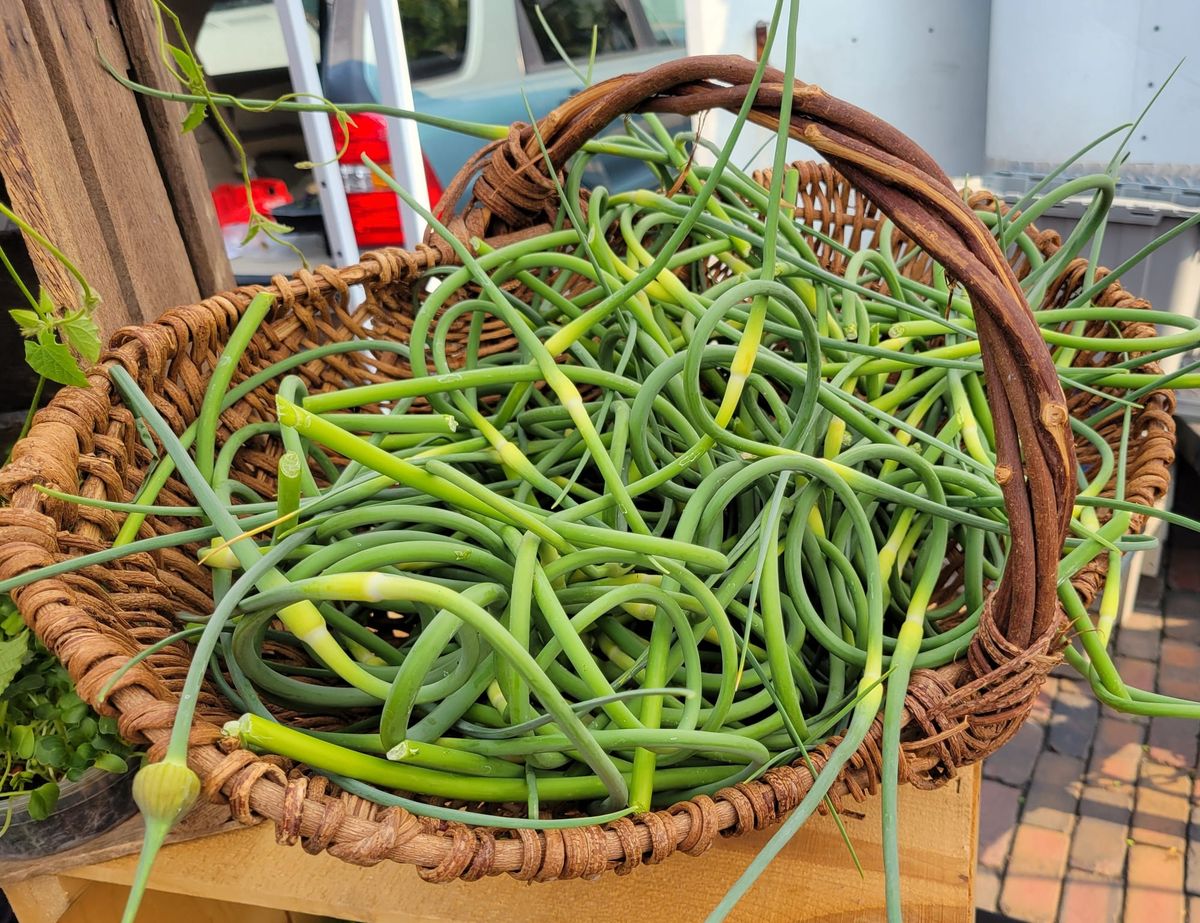
Scapes appear at the farmers market and MOON as a tangled mess of long thin green wires, around 2 feet long and 1/4 inch in diameter. Our local growers have too many of them, but only for a couple of weeks in June. So, they display mounds of intertwined scapes, challenging shoppers to successfully extract only a few. To move the mountain of scapes in just a couple of weeks, our growers charge a low price for a handful of them.
A scape is the tender stalk and flower bud of a hardneck garlic plant. A garlic bulb grows underground while the stalk gets the sunshine above ground. The stalk grows straight up for a few inches then curls once or twice before continuing to grow. If left unharvested, a flower eventually blooms at the end of the stalk. However, growers cut off the stalk before flowering so the plant can channel more energy into producing a larger more flavorful garlic bulb ready for harvesting in a few weeks.
As the scape curls, it develops a bulge in the middle. This is an unopened flower bud, containing garlic seeds. The bulge is edible but is less tender than the rest of the scape.
I’ve devoted little space here to cooking with scapes. The reason is simple: use them in almost anything you prepare this time of year. If you are cooking in a wok or in a frying pan on the stovetop, add finely chopped scapes to whatever else you are cooking – spaghetti sauce, stir-fry, omelet, chopped veggies or whatever. If you are baking something in the oven, add chopped scapes to the pan.
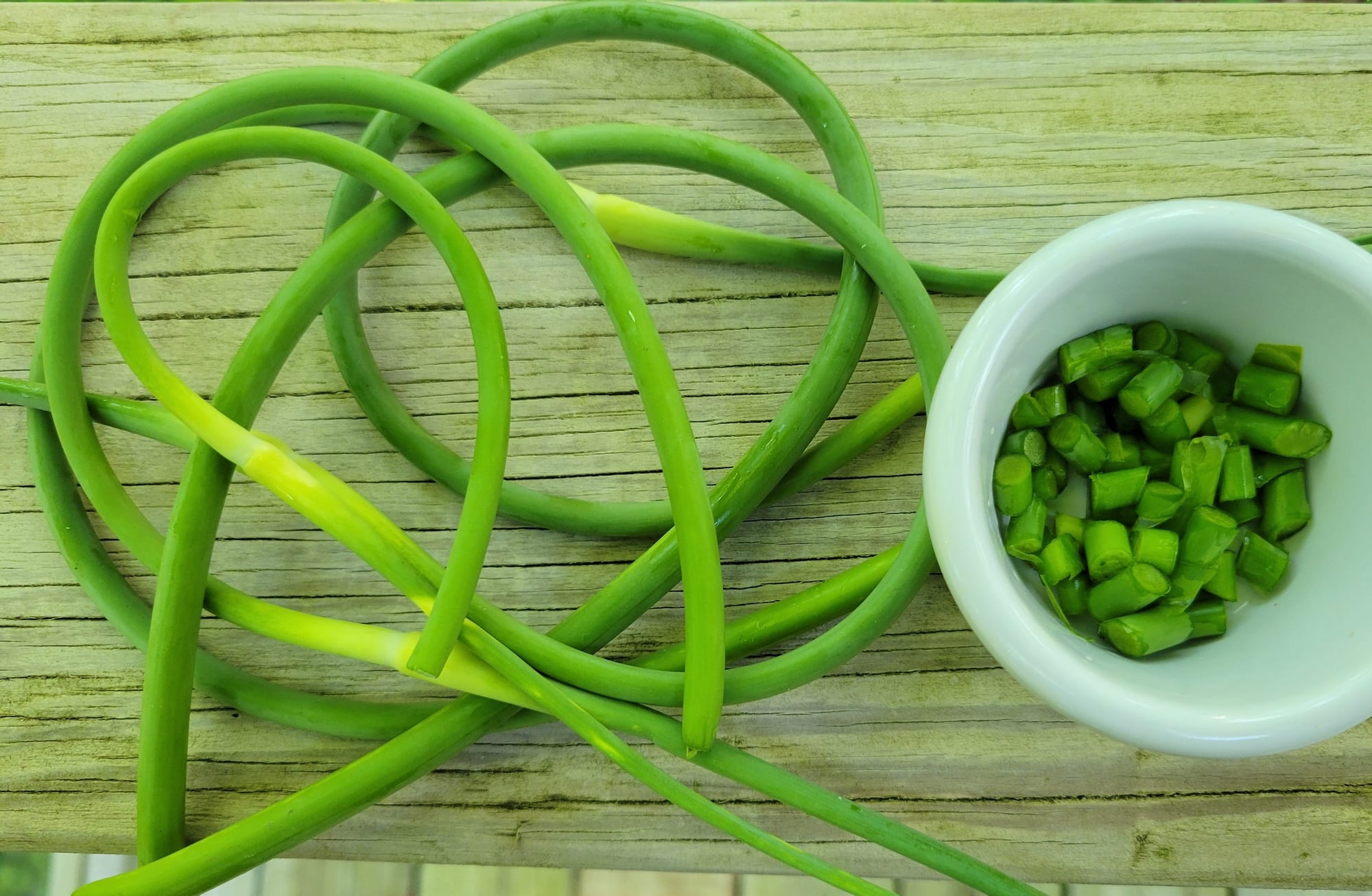
Scapes don’t have to be cooked. Instead of onion, sprinkle chopped raw scapes on top of a hamburger. Pesto is an especially useful choice when inevitably one is left with an excessive number of scapes. Pulse raw scapes in a food processor, along with kale or other leafy greens and olive oil. Add to the processor some nuts, such as walnuts or pistachios, and some Parmesan cheese. Season to taste with lemon, salt and pepper.
Scapes freeze well. Unlike most green vegetables, scapes retain their crunchy texture when thrown from the freezer into the pan or oven. They also keep well for a couple of weeks in the fridge.
“All About Strange Vegetables,” a blog by Simple Seasonal, writes that scapes “strongly qualify as a strange vegetable. First of all, they look like some kind of alien antennae.” To reinforce the claim, the blog includes a photograph of a child with a scape emerging from each ear.
“Scapes are to garlic as fusilli is to rigatoni: the crazy college buddy who never really embraced adulthood,” writes Carolyn Cope in Serious Eats. I have no idea what this means.
I do know that Oxford’s scapes season is very short, so grab a handful now. Soon enough, local garlic bulbs, for which the scapes were sacrificed, will be available at Oxford’s Farmers Market and MOON Co-op Grocery.
James Rubenstein is president of the Board of Directors for the Oxford Free Press and professor emeritus of geography at Miami University.